Slow Breathing and the Nervous System: What Science Shows, and What Traditions Understood First
The autonomic nervous system, the vagus nerve, HRV and 0.1 Hz — what the research supports, what it does not, and what pranayama, the Tao and the Hebrew ruach were actually saying.
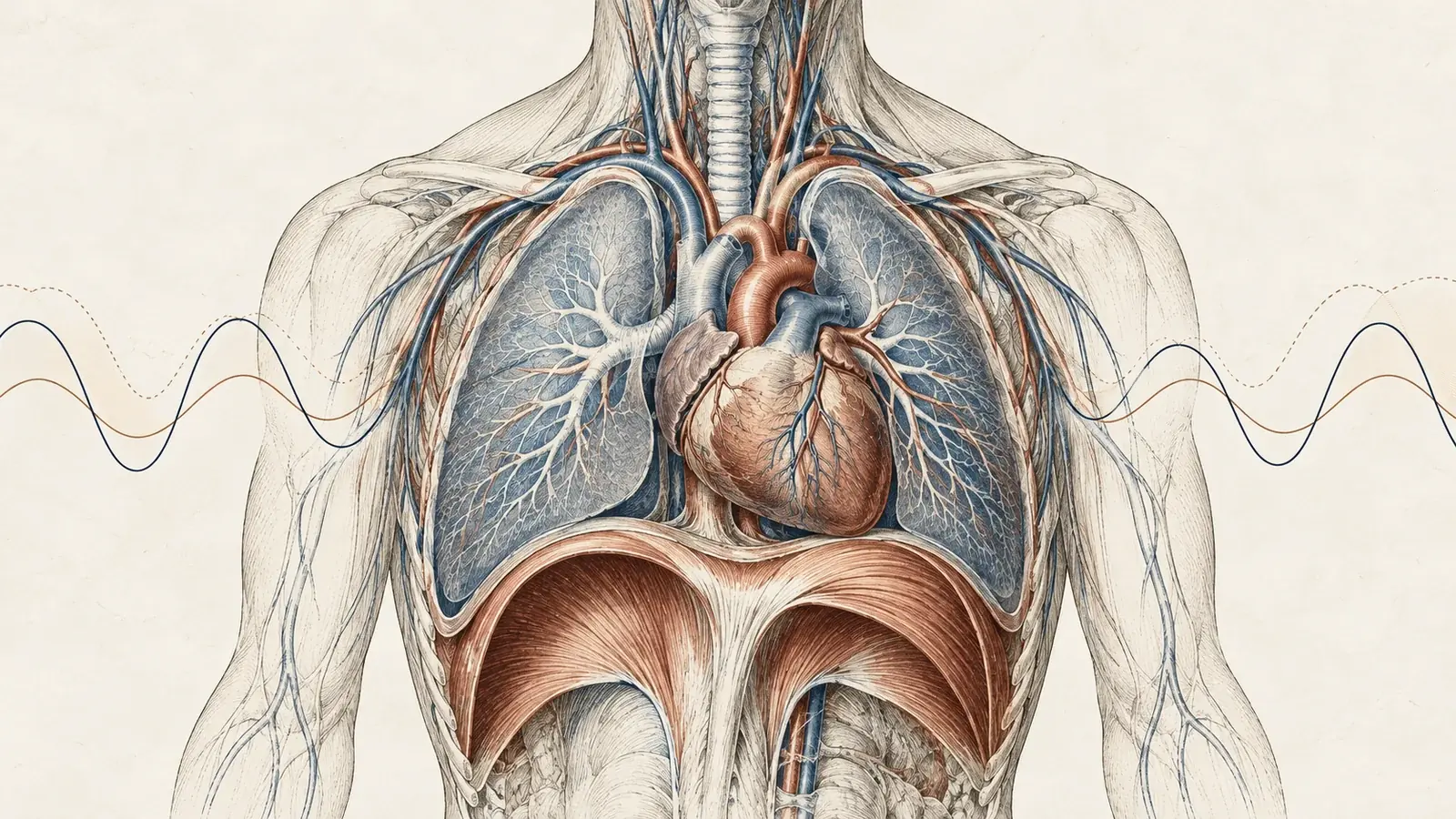
There is something almost absurd about modern human beings. We are constantly searching for new ways to change our state of consciousness — apps, courses, supplements, meditation programmes, workshops, devices that measure our bodies and other devices promising to teach those same bodies how to relax.
Meanwhile, we walk around with a biological system that performs tens of thousands of breathing cycles every day, without asking our permission or charging us a monthly subscription.
The breath. Not a new invention. Not a method belonging to one guru or another. Not even something you have to believe in. An ancient physiological process that sustains life, while remaining closely connected to our nervous system, heart, brain and emotional state.
When we are afraid, our breathing may change. When we exert ourselves, it changes again. When we fall asleep, laugh, cry, become excited or prepare for danger, the body adjusts its breathing pattern accordingly. But there is one extraordinary detail: unlike most of the body’s autonomic processes, breathing is something we can also choose to change voluntarily. And that same process, which usually happens without conscious attention, becomes a doorway we can deliberately open.
Yogic traditions in India, Taoist sages in China and other spiritual traditions regarded the breath as one of the keys to working with consciousness. Today, scientists are investigating what happens when we slow it down, change the duration of inhalation and exhalation, or synchronise breathing with a particular rhythm. Are they studying exactly the same thing? No. But there is a fascinating meeting point between them.
So let us explore what we actually know, what remains uncertain, and what we can take from all of this into everyday life.
The short answer: what does slow breathing do to the nervous system?
Slow, controlled breathing, generally at fewer than ten breaths per minute, can influence the coordination between breathing, heartbeats and blood-pressure regulation. Many studies have observed changes in heart rate variability (HRV), sometimes accompanied by reduced physiological arousal and perceived stress.
Some research also suggests improvements in emotional wellbeing following regular practice. However, it has not been established that every slow breathing rhythm is superior to comfortable breathing at a normal pace, or that the same technique works equally well for everyone.
The point is not to breathe as slowly as humanly possible. The point is to find a comfortable, unforced breathing pattern and learn how your body responds to it.
The autonomic nervous system: your body reacts before you have finished thinking
To understand why breathing affects us, we need to meet one of the most impressive operating systems in the human body: the autonomic nervous system. It helps regulate heart activity, blood vessels, digestion, sweating and numerous other internal processes without requiring us to manage each one consciously.
For simplicity, we often describe two major branches. The sympathetic nervous system helps mobilise resources when the body needs to act: confronting a threat, performing physical work, remaining alert or responding quickly. The parasympathetic nervous system contributes to processes including heart-rate regulation, digestion and recovery, through various nerves and physiological mechanisms.
But there is an important correction to make to the language commonly used in the wellness industry. The sympathetic nervous system is not the bad guy, and the parasympathetic is not the good guy. We need both. Without the ability to enter a state of activation, we could not respond effectively to danger. Without the ability to recover, the body would struggle to return to an appropriate state once a threat had passed.
Health is not the absence of arousal. It also involves the ability to move between states according to what life requires.
The difficulty begins when we struggle to make that transition. When an event that ended hours ago continues to keep us on edge. When the mind knows we are safely at home, but the body is still behaving as though something terrible is about to happen.
And this raises an interesting question: can we use the breath to influence some of these regulatory mechanisms? Research suggests that we can, at least in certain physiological measurements and some emotional responses. But it is worth understanding how.
The vagus nerve: not a magic switch, but part of a complex system
The vagus nerve, also known as cranial nerve X, is one of the major nerves associated with the parasympathetic nervous system. It connects the brainstem with various organs and systems, including the heart, respiratory system and digestive tract.
In recent years it has become something of a celebrity in the healing and wellness world. We hear about “activating the vagus nerve”, “resetting the vagus nerve”, or “releasing trauma through the nerve”. But a nerve is not a button, and the nervous system does not work like a light switch.
When we breathe, changes occur in pressure within the chest, in blood returning to the heart, in pressure-sensitive receptors and in neural signals involved in regulating heartbeats. Breathing rhythm can influence these interactions.
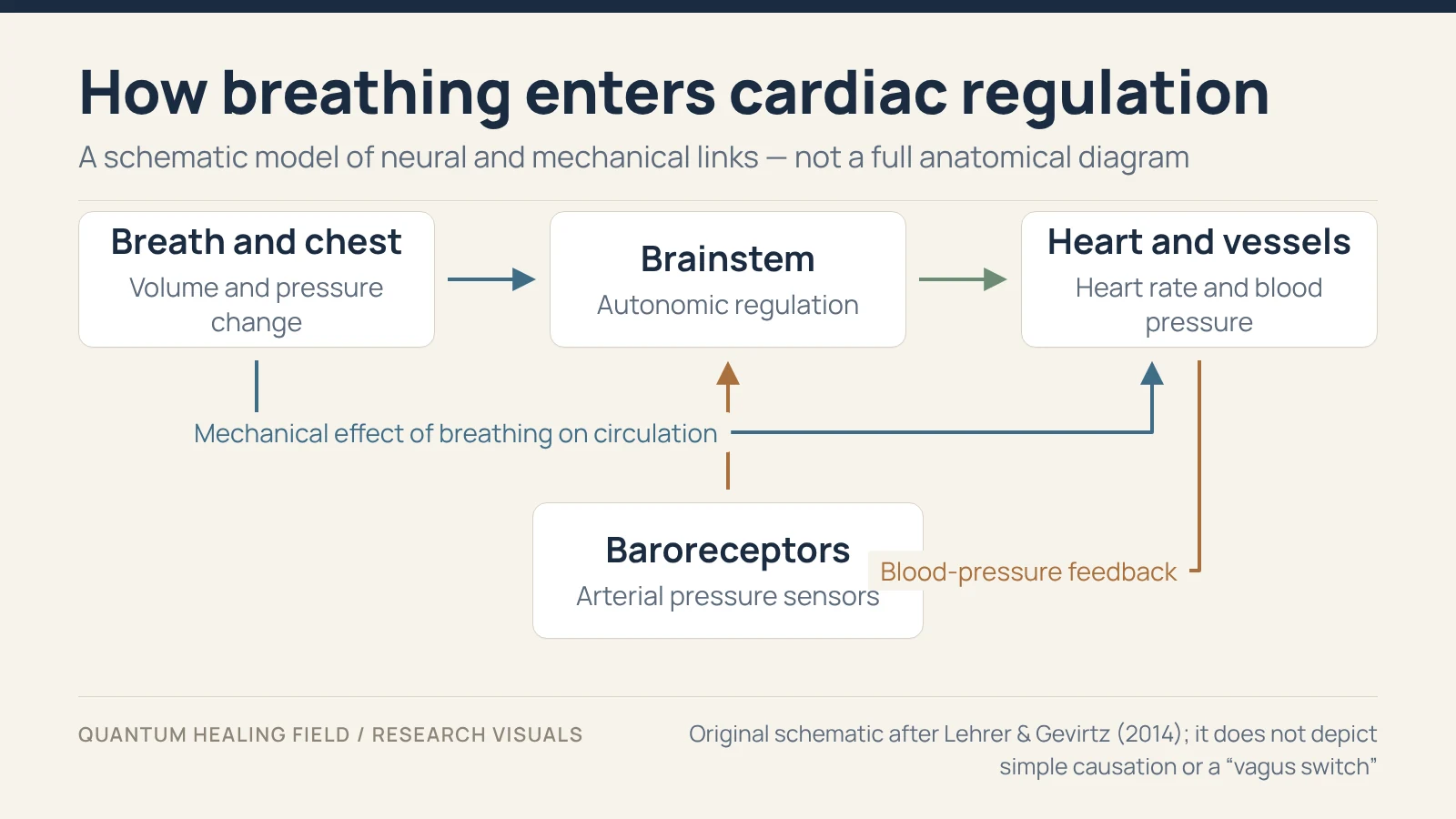
The relationship between brain and body is also not a one-way street. The brain influences breathing, while information from the body travels back towards brain networks involved in internal bodily awareness, alertness and emotional regulation.
Rather than discussing vagus nerve activation as though it were a simple trick, it is more accurate to speak about influencing autonomic regulatory mechanisms and the continuous communication between the brain, heart and breath. And that communication has a particularly interesting measurable feature.
Heart rate variability: your heart is not supposed to tick like a metronome
Many people assume that a healthy heart is one that beats at a perfectly constant rhythm. In reality, even when the average heart rate remains stable, the intervals between individual heartbeats vary slightly. This variation is known as heart rate variability, or HRV.
One of the factors influencing HRV is breathing itself. In many people, heart rate tends to increase slightly during inhalation and decrease during exhalation. This phenomenon is called respiratory sinus arrhythmia (RSA). Do not let the word “arrhythmia” frighten you: in this context it describes a normal physiological phenomenon, not necessarily a heart rhythm disorder.
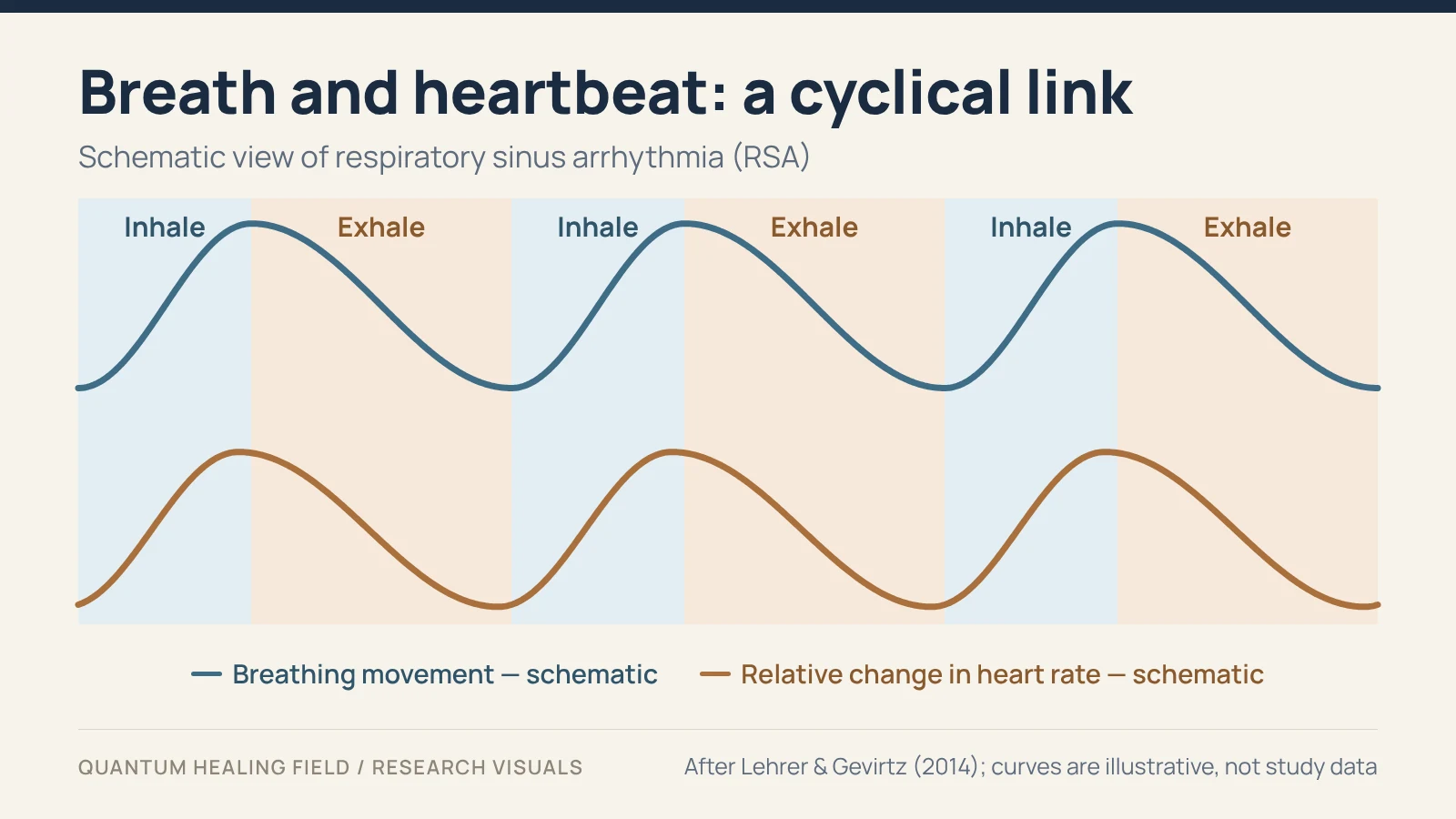
When we change our breathing rhythm, we can also change the pattern of these heart-rate fluctuations. Numerous studies have found that slow breathing, particularly around five to six breaths per minute, can increase these oscillations.
But we should be extremely careful not to turn HRV into a scorecard for the human soul. HRV is influenced by age, health, sleep, physical activity, medication, time of measurement and breathing patterns. A higher reading during a breathing exercise does not, by itself, prove that long-term nervous-system regulation has improved.
HRV is a physiological measurement. It is not a measure of enlightenment, consciousness, or someone’s “spiritual frequency”.
Still, it allows us to observe something remarkable. The heart and lungs are not two independent machines. They belong to a living system that continuously coordinates itself.
Six breaths per minute: what does the 0.1 Hz frequency actually mean?
Now we enter the realm of physics — actual physics, without mystical shortcuts. When we breathe six times per minute, each complete breathing cycle takes ten seconds. One cycle every ten seconds corresponds to a frequency of 0.1 hertz (Hz).
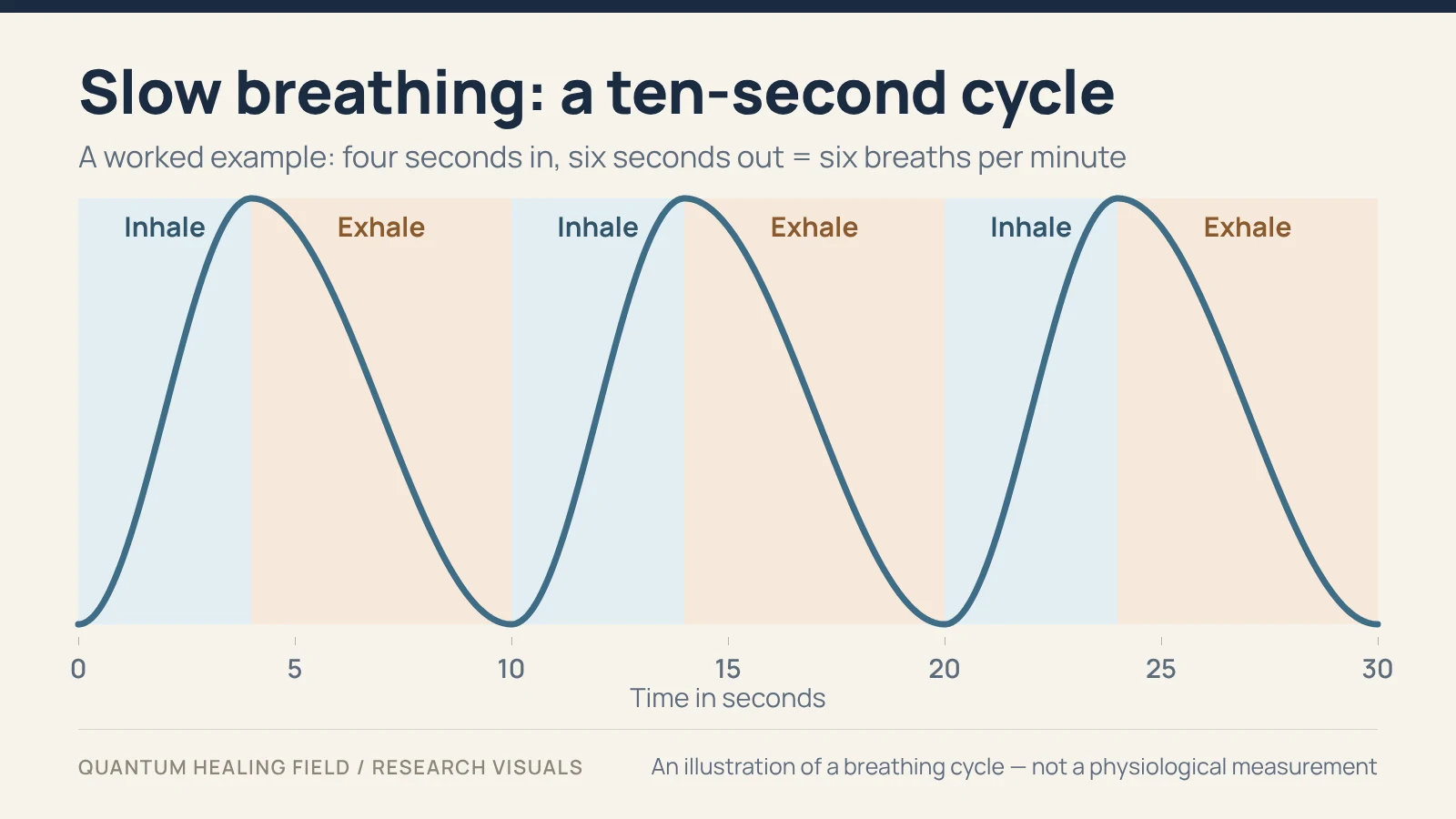
This is an interesting frequency range in physiological research, because many people demonstrate increased cardiovascular oscillations around this rhythm, particularly in mechanisms associated with breathing and blood-pressure regulation. The phenomenon is sometimes described as resonance frequency breathing.
One mechanism involved is the baroreflex: a feedback system that helps regulate blood pressure through responses involving the heart and blood vessels. When breathing frequency aligns with the dynamics of this system, the resulting oscillations may become more pronounced.
But pay attention to the word resonance. It does not mean we have connected ourselves to a secret frequency of the universe. It describes the response of a physiological system containing rhythms and feedback mechanisms.
And there is no single sacred number here. The breathing frequency that produces the strongest response varies between individuals. For some it is close to six breaths per minute; for others it may be slightly higher or lower. There is no scientific basis for claiming that every human being must breathe exactly six times per minute to achieve good health.
What does the research actually show?
Here I want to do something the healing industry does not always do: examine the studies that support the idea — and those that force us to be more precise.
The 2018 systematic review: breathing, body and brain
A research team led by Andrea Zaccaro published a systematic review in Frontiers in Human Neuroscience examining the psychophysiological correlates of slow breathing. From 2,461 initial records, 15 studies met the researchers’ inclusion criteria.
The review identified possible changes in heart rate variability, patterns of brain activity, and psychological measures such as relaxation, alertness and arousal. However, the researchers emphasised that the underlying mechanisms were not yet fully understood and that the number of eligible studies was relatively limited.
The conclusion was not that slow breathing “reprograms the brain”. The conclusion was that measurable relationships exist and deserve further investigation.
The 2023 meta-analysis: small to moderate improvements in stress
In a systematic review and meta-analysis published in Scientific Reports, Guy Fincham and colleagues examined randomised controlled trials of breathwork interventions. The main analysis included 12 studies involving 785 participants.
The researchers found a small-to-moderate effect in favour of breathwork for reducing self-reported stress compared with control conditions. Encouraging findings also emerged in analyses of anxiety and depressive symptoms. However, most studies were rated as having at least some concerns regarding risk of bias, and the quality of control conditions varied.
This is a distinction worth remembering. A statistically positive result does not mean that every person will experience the same benefit. And it certainly does not turn breathwork into a replacement for appropriate professional care.
The 2023 Stanford study: five minutes a day
In a remote randomised study, Stanford researchers compared three structured breathing exercises with mindfulness meditation. Participants were asked to practise for five minutes a day over approximately one month.
One technique, known as cyclic sighing, involved a double inhalation followed by a prolonged exhalation. It demonstrated certain advantages in improving positive mood and reducing respiratory rate compared with the mindfulness meditation condition tested.
But that does not establish cyclic sighing as the best technique for every person, nor does it prove that all breathwork is superior to all meditation. The study examined specific protocols, in a particular group, over a defined period.
What happens when we use a more rigorous active control?
In another study published in December 2023, researchers randomised 400 participants into two groups. One practised coherent breathing at approximately 5.5 breaths per minute; the other practised guided breathing at approximately 12 breaths per minute. Both groups practised for around ten minutes a day over four weeks.
Both reported improvements in certain outcomes over time. But the slower breathing intervention did not demonstrate a significant advantage over the active control condition for the mental health and wellbeing measures examined.
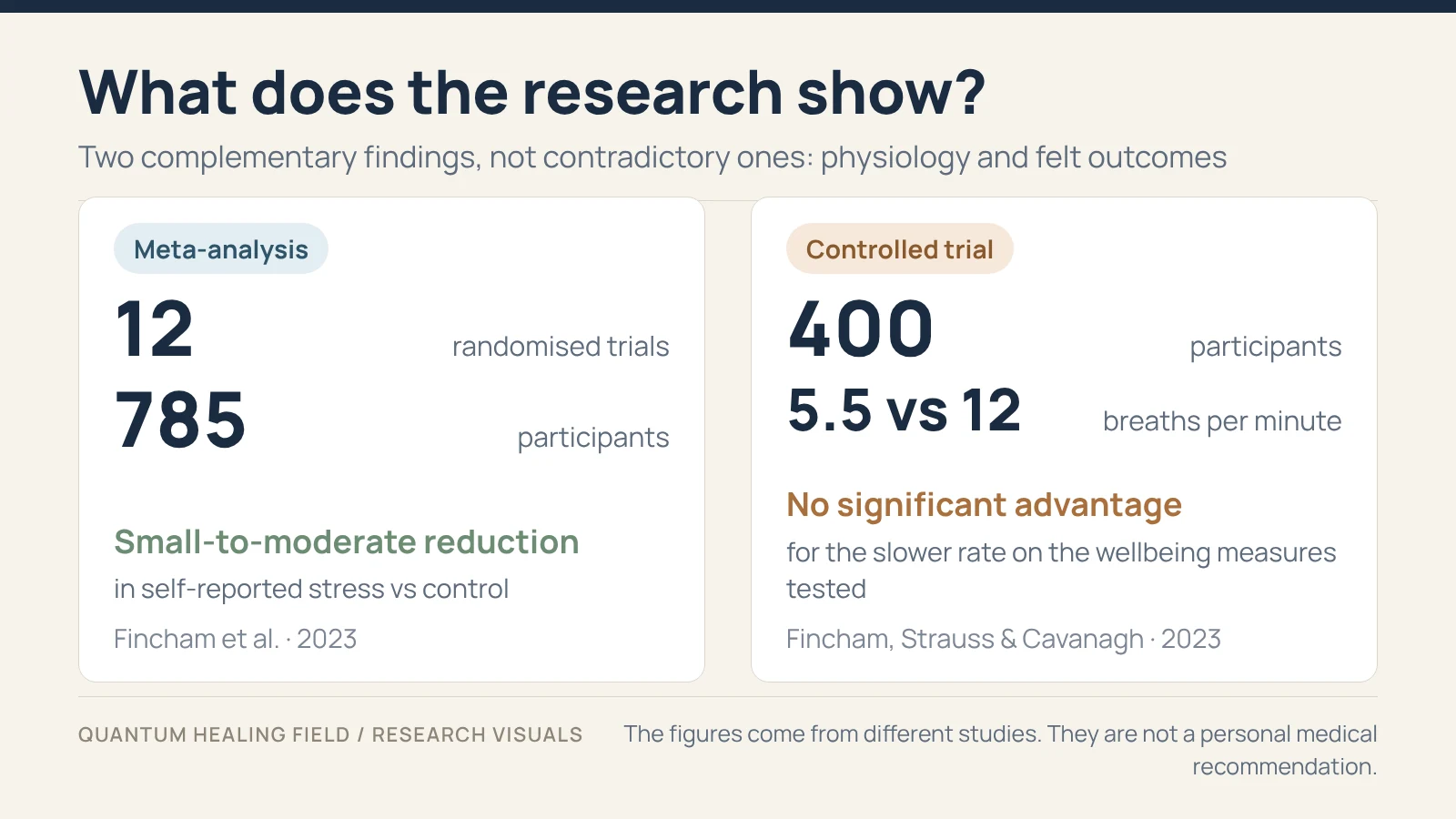
This is an important result. It does not invalidate the physiological findings concerning HRV. But it reminds us that dedicating time to quiet, structured attention and breathing may itself have value, even when the breathing rhythm is not the exact so-called resonance frequency.
And what have the 2026 studies added?
A study published in the International Journal of Psychophysiology in 2026 examined 166 younger and older adults. Researchers compared breathing at six breaths per minute with paced breathing at twelve breaths per minute during an emotional memory task.
They observed differences in certain emotional responses and memory outcomes. However, the effects were not uniform across age groups, and changes in HRV did not provide a simple explanation for all the findings. The study’s title says quite a lot: breathing slower is not always better.
Another systematic review published in 2026 examined slow breathing techniques performed before bedtime. It included nine studies involving 457 participants. The findings suggested potential improvements in self-reported sleep quality and sleep duration. However, results from objective sleep measurements were less consistent. Once again, there is potential, but not enough evidence to justify universal promises.
| The question | What is supported | What is not |
|---|---|---|
| Effects on heart and breath | Measurable changes in HRV and in breath–heart coordination during practice. | That this momentary change proves long-term improvement in nervous-system regulation. |
| Effects on stress and anxiety | A small-to-moderate effect on self-reported stress compared with controls. | That breathing practice replaces professional care for anxiety or depression. |
| The optimal rate | That around five to six breaths per minute, many people show a heightened physiological response. | That one number is right for everyone, or that slower is always better. |
| Sleep | Signs of improvement in self-reported sleep quality and duration. | Consistent improvement in objective sleep measurements. |
| The vagus nerve | Influence on autonomic regulatory mechanisms that the vagus nerve participates in. | “Activating”, “resetting” or “healing” the nerve as a discrete action. |
The research takeaway: slow breathing produces measurable physiological effects and may support psychological wellbeing. However, there is still no evidence that one particular slow-breathing protocol is universally optimal, or necessarily more effective than other forms of attentive breathing.
Does breathing through the nose really affect the brain?
Breathing is not only about rhythm. The route air takes may also matter. Airflow through the nasal cavity creates sensory stimulation that research has linked to activity in various brain systems, including pathways associated with smell.
In a small 2026 study published in Scientific Reports, researchers examined patterns of brain connectivity during nasal breathing compared with mouth breathing. The final analysis included data from 20 healthy adult men. Researchers observed differences in how brain networks coordinated with one another under the two breathing conditions.
This is genuinely interesting. But a small brain-imaging study does not prove that nasal breathing makes us more intuitive, more intelligent or more connected to higher consciousness. Nor does it mean that anyone should force nasal breathing when experiencing congestion, illness or breathing difficulties.
For people who find it comfortable, gentle nasal breathing can be a reasonable option during relaxation practice. For everyone else, the practice should be adapted to their physical reality.
Wait — what about carbon dioxide?
One of the most common misconceptions about breathing is that taking in more air must always be better. But the respiratory system is not a machine designed solely to maximise oxygen intake. It also helps regulate carbon dioxide (CO₂) levels and maintain the body’s normal acid-base balance.
Breathing too quickly or too deeply can reduce carbon dioxide levels in the blood. In some circumstances this may produce dizziness, tingling, a sensation of breathlessness or heart palpitations — sensations that can themselves intensify fear.
That is why slow breathing is not an invitation to force enormous amounts of air into the lungs. In the type of practice we are discussing, breathing should remain quiet, comfortable, continuous and unforced.
Not every intense sensation is an “energetic release”. Sometimes dizziness is simply dizziness — and knowing the difference matters.
Long before HRV: breathing in ancient wisdom traditions
Now we can open the second door. Not the door of medical measurement, but the door of human, spiritual and philosophical interpretation. Thousands of years before we could measure heart rate variability, human beings had already recognised a relationship between breathing and inner experience. Different cultures gave that relationship different names, developed practices around it and constructed entire worlds of meaning.
Pranayama: between breath and consciousness in yoga
Within traditional yogic philosophy, prāṇa refers to vital life energy or life force. Prāṇāyāma refers to a broad family of practices involving intentional regulation of breathing. These may include changes in breathing rhythm, duration, inhalation and exhalation patterns, and sometimes breath retention.
In Patañjali’s Yoga Sūtras, particularly sūtras 2.49–2.53, breath regulation is associated with preparing the mind for concentration. In the Haṭha Yoga Pradīpikā, chapter 2, verse 2, a relationship is described between the movement of breath and the restlessness of the mind, and between steadiness of breath and steadiness of mind.
I find something remarkably perceptive in that distinction. These texts are not simply saying, “Relax.” They present breathing as part of a discipline of attention. Not a momentary trick. A practice.
But prāṇa is not another word for oxygen, and the subtle energy channels described in yogic traditions are not scientifically verified anatomical maps of nerves and blood vessels. We can explore their philosophy, practise techniques inspired by them and appreciate the accumulated human experience within these traditions. We do not need to force them into modern biology to acknowledge their value.
Taoism: breathing from the heels
In the ancient Chinese text Zhuangzi, within the chapter commonly translated as The Great and Most Honoured Master, we encounter a striking image. The breathing of the true or perfected person is described as reaching all the way to the heels, while ordinary people’s breathing reaches only the throat.
Was the author suggesting that air literally travels through an anatomical passage into our heels? That is hardly the most reasonable reading. This is philosophical and embodied language describing depth, presence and integration. Breathing is no longer experienced merely as a local movement in the throat or chest; it becomes part of one’s entire way of being in the world.
And there is something worth considering here. A person can follow a breathing exercise perfectly, counting every second, while remaining completely absorbed in the struggle to control themselves. Meanwhile, someone else may breathe naturally and comfortably, without an app or special technique, and experience a genuine sense of stability. Taoist thought invites us not only to regulate breathing, but also to ask whether we can stop fighting it.
Ruach, breath and soul in the Hebrew tradition
And within the Hebrew language itself lies another extraordinary world. Neshimah. Neshamah. Ruach. Breath. Soul. Spirit. Words that, each in their own way, connect the experience of life with something beyond the image of inert matter.
In Genesis 2:7, humanity is formed from the dust of the ground, and the breath of life — nishmat chayim — is breathed into the human being. The verse is not a physiology textbook. But symbolically, it places breath at the very moment the formed body becomes a living being. The Aramaic translation of Onkelos also connects this moment with the idea of ruach memallela — a speaking spirit, or a being endowed with speech.
In Sefer Yetzirah, the Book of Formation, we find a symbolic framework involving three mother letters: aleph (א), mem (מ) and shin (ש). These are associated with air, water and fire. Within that symbolic system, air serves a role of mediation and balance.
We may approach these ideas as theology, as mysticism of language, or as an ancient meditation on the relationship between life, speech and breathing. But it would be inaccurate to claim that Sefer Yetzirah described the parasympathetic nervous system or predicted modern HRV research. It was working within a different conceptual universe.
Still, I love the fact that the Hebrew word ruach can evoke wind, breath, spirit and an inner dimension of human existence. Not as scientific proof that everything is literally the same phenomenon, but as a reminder that human beings were contemplating the relationship between breath and life long before they possessed instruments capable of measuring it.
When science and ancient traditions meet: what do they actually share?
We often hear that modern science is merely rediscovering what the ancients already knew. I think that statement is incomplete.
Ancient traditions developed practices, philosophies and systems of understanding through observation and experience accumulated over generations. Science attempts to investigate causal relationships, measure responses, compare control groups and identify alternative explanations. These are different ways of knowing. Sometimes they converge around the same human experience.
For example, a person sits down, gently slows their breathing and turns their attention inward. They may notice a shift in how they feel. Yoga may interpret that experience through the framework of prāṇa and concentration. Taoism may describe harmony and alignment with the Way. Hebrew mystical tradition may invite questions about ruach and neshamah. Physiology may examine changes in respiration, heart rate, regulatory mechanisms and brain activity.
The same experience can invite multiple layers of understanding without automatically making them the same claim.
To me, that is a far more interesting way to explore consciousness. Not deciding in advance which language must win, but knowing which language we are speaking at any given moment.
A practical exercise: five minutes of gentle, conscious breathing
After all the research and ancient traditions, it is worth returning to the breath itself. You do not need special equipment, a particular audio frequency or an altered state of consciousness.
The following exercise is a general option for healthy adults, inspired by principles of gentle paced breathing. It is not a medical protocol, nor is it a performance test.
- Find a comfortable position. Sit comfortably or lie down somewhere quiet. There is no need for a special ceremonial posture. You may keep your eyes open and simply notice the support of the chair or the ground beneath you.
- Observe before changing anything. For approximately thirty seconds, simply notice your breathing as it is. Do not improve it. Do not correct it. Just notice.
- Slow down gently, without forcing. You can try inhaling comfortably for about four seconds, followed by a relaxed exhalation lasting around six seconds — a ten-second cycle, equivalent to six breaths per minute. But this is an example, not a requirement. If the timing feels unnatural, shorten it, breathe at your usual rhythm, or abandon counting altogether. There is no need to fill your lungs to their limit, and no need to hold your breath.
- Listen to your body’s response. Continue for a minute or two. If it remains comfortable, gradually extend the practice to about five minutes. Are your shoulders a little less tense? Does the rhythm feel natural? Has anything in your experience changed — or perhaps nothing at all? Even if you experience no dramatic shift, the exercise has not “failed”. The goal is not to produce a vision or a feeling of euphoria, but to become better acquainted with your own body.
- Return to natural breathing. Release the counting and allow the breath to return to its natural rhythm. Give yourself a moment before standing up. You can repeat the exercise daily if it feels comfortable and appropriate.
Can breathing help when life is genuinely difficult?
Perhaps this is the most important human question of all. It is easy to talk about nervous-system regulation in a quiet room, with gentle music and soft lighting. It is somewhat harder to remember to breathe when the telephone rings with terrible news, when a relationship is falling apart, when financial concerns are keeping us awake, or when the mind refuses to give us a moment of peace.
And I have no interest in selling illusions. Five minutes of breathing will not pay the electricity bill. It will not resolve a toxic relationship. And it will not replace the difficult work sometimes required to change our reality.
But it may occasionally help us meet that reality with a little less physiological arousal. Not so we can pretend everything is fine, but so we may be better able to think, feel and choose how to respond. And that is a substantial difference.
In my work with consciousness, I am not interested only in extraordinary experiences. Sometimes the most meaningful moment is the one in which someone recognises that they do not have to respond immediately to every thought, every fear or every impulse that arises. Breathing can become part of that practice — not because it makes the difficulty disappear, but because it gives us an opportunity to notice the difficulty without immediately allowing it to govern our entire response.
If stress, anxiety or low mood have been with you for a long time and are affecting sleep, work or relationships, the Anxiety, Low Mood & Emotional Wellbeing page describes complementary support — not psychotherapy, and not medical treatment.
Breath runs through everything I do — and that is not a coincidence
When I look back at everything I have studied and everything I offer today, one thing recurs in all of it. Not always as a method, and not always under that name. But it is there.
In BQH and QHHT, the relaxation that opens a session rests on the breath. Not a special breath and not a precise count — the slowing itself, which lets the body stop defending long enough for something else to surface.
Before intuitive channeling I steady the breath, mainly to tell the difference between an impression arriving out of quiet and one arriving out of pressure. That is a distinction I have written about separately in Intuition, Fear or Projection, and the breath is one of the few practical tools I have for it.
In energy work the breath is the metronome. And in breathwork it is no longer a support — it is the work itself.
And now the part I want to say explicitly, so that nothing more is read into it than was said: the fact that breathing appears in all of these does not make it the mechanism that explains them. Each of these approaches has its own context, its own open questions, and a completely different level of evidence behind it. The breath is the shared doorway, not the shared explanation.
What it does give is a place to begin. It is available without equipment, without prior belief, and without deciding in advance where a process is going. Which is why, almost always, it is the first thing I ask someone to notice — before we have chosen which tool to use at all.
Why I don’t treat breathwork as one single method
Throughout my studies in breathwork, including learning through the work of Dan Brulé, I have encountered a remarkable range of approaches.
Some practices are slow and gentle, designed to support relaxation and focused attention. Others are more rhythmic and intense. Some incorporate sound, movement, visualisation or group experiences. And some belong to ancient traditions in which breathing forms part of a much broader spiritual discipline.
I believe one of the greatest mistakes is treating all these practices as though they were identical simply because they all involve breathing. The technique matters. The rhythm matters. The context matters.
But the person matters more than the protocol.
What suits one person may not suit another. What feels right on one particular day may feel entirely wrong on the next. This is also why I prefer to listen first and choose the tools afterwards — something I have written about at length in Why I Don’t Work With Just One Method.
Ultimately, the goal is not to become an expert in holding your breath or counting seconds. The goal is to learn to live with a little more presence.
Breath, consciousness and the freedom to choose
We tend to imagine that freedom of choice begins in the mind. I believe that sometimes it begins a moment earlier. With the ability to notice that the body has become tense. That the jaw has tightened. That the breath has become fast or shallow. That we are already preparing for battle, even though we have not yet decided whether there is anything worth fighting.
Conscious breathing does not guarantee that we will make the right decision. It does not make us immune to fear or anger. But it can become a small reminder to return to the present moment. To feel. To observe. To examine. And only then, to choose.
Perhaps that is one reason so many ancient traditions devoted such attention to breathing. Not because they knew how to measure HRV, but because they recognised that breathing accompanies us everywhere, and that the way we breathe is deeply connected to the way we experience being alive.
I think there is a beautiful lesson here for our own times. We live in a world that is constantly trying to accelerate us. Capture our attention. Trigger another reaction. Pull us into another conflict. And within all that noise remains one simple, accessible act — one we do not have to turn into a religion, a method or a business.
To breathe.
Not to escape the world. But to return to it.
Frequently asked questions
Does slow breathing activate the vagus nerve?
Slow breathing can influence autonomic regulatory mechanisms that involve the vagus nerve, but saying it simply “activates the vagus nerve” is an oversimplification. The effects involve interactions between respiration, heart rate, blood pressure and neural feedback.
What is the recommended breathing rate?
Many studies investigate rates around five to six breaths per minute, but the appropriate rhythm varies between individuals. Comfortable, unforced breathing matters more than reaching any particular number.
Why is six breaths per minute mentioned so often?
Six breaths per minute corresponds to a frequency of 0.1 Hz. Near this frequency many people show a resonance-like response involving cardiovascular and respiratory regulation. It is a physiological phenomenon, not a universal spiritual frequency.
What is heart rate variability (HRV)?
Heart rate variability measures differences in the intervals between successive heartbeats. It is influenced by breathing and autonomic regulation among other factors, but it is not a direct measurement of relaxation or spiritual consciousness.
Can slow breathing reduce anxiety?
Some studies suggest breathing exercises may help reduce stress and anxiety symptoms. Results are not uniform and research quality varies. Breathing exercises can be complementary tools, not substitutes for appropriate professional care.
Is it better to inhale through the nose and exhale through the mouth?
Gentle nasal breathing is a common option, and exhaling through the mouth is also fine if it is comfortable. There is no need to force a particular pattern when it causes difficulty.
Can slow breathing improve sleep?
A 2026 systematic review found encouraging improvements in self-reported sleep quality and duration, while objective measurements produced less consistent findings. There is potential, but stronger research is still needed.
What is the difference between slow breathing and pranayama?
Slow breathing describes a breathing rate. Pranayama refers to a much broader system of breath-related practices within the yogic tradition. Some are slow and gentle; others differ considerably in structure and intensity.
Sources
- Zaccaro et al. (2018) — How Breath-Control Can Change Your Life, Frontiers in Human Neuroscience
- Fincham et al. (2023) — Effect of breathwork on stress and mental health: meta-analysis, Scientific Reports
- Balban et al. (2023) — Brief structured respiration practices, Cell Reports Medicine
- Fincham, Strauss & Cavanagh (2023) — Coherent breathing: randomised placebo-controlled trial, Scientific Reports
- The Effect of Slow-Paced Breathing on Cardiovascular and Emotion Functions — Mindfulness
- Lehrer & Gevirtz (2014) — Heart rate variability biofeedback: how and why does it work?, Frontiers in Psychology
- Laulan & Rimmele (2026) — Breathing slower is not always better, International Journal of Psychophysiology
- Eide, Hernes & Grønli (2026) — Slow breathing techniques before bedtime: a systematic review, Sleep Medicine Reviews
- Mohammadi, Hossein-Zadeh & Raoufy (2026) — Nasal and oral breathing modes reconfigure brain network dynamics, Scientific Reports
- NHS — Breathing exercises for stress
- Cleveland Clinic — Hyperventilation
Traditional sources
- Yoga Sūtras of Patañjali, 2.49–2.53Breath regulation as preparation of the mind for concentration.
- Haṭha Yoga Pradīpikā, chapter 2, verse 2Movement of the breath and restlessness of the mind described together.
- Zhuangzi — The Great and Most Honoured MasterThe passage on breathing from the heels.
- Genesis 2:7 with Targum OnkelosNishmat chayim, and Onkelos reading it as ruach memallela.