The Approach
You Are Not a Protocol
My integrative, intuitive, person-centered approach.
Integrative healing, in practice: Two people can arrive with the same sentence and mean entirely different things by it. So the work doesn’t start with a technique. It starts with listening.
Why not one method?
When a practitioner has only one method, every person starts to look like a candidate for that method. The technique quietly becomes the point, and the person becomes the material it’s applied to.
I trained across many approaches partly so that wouldn’t happen. Having more than one way to work means I don’t have to force anyone into the one way I happen to know.
How a session actually takes shape
We begin with conversation — what you’re bringing, what’s been sitting with you, what you’re curious about. I listen to what’s said and to what sits underneath it.
From there, what happens is chosen in the moment rather than from a script. Depending on what emerges, a session may draw on intuitive and energetic work, a guided inward journey, breath, sound, symbolic exploration, or simply quiet reflection. Often it’s a blend. Sometimes the most useful thing is far simpler than what either of us expected.
What you don’t need to bring
You don’t need a belief system. You don’t need prior experience with meditation, energy work or inner journeying. You don’t need to arrive with the right words for what you’re feeling — finding those words is often part of the work.
What this is — and what it isn’t
This is complementary, exploratory, wellbeing-oriented work. It is not medical or psychological diagnosis or treatment, it doesn’t replace care from a licensed professional, and it doesn’t promise a fixed outcome.
What it offers is a space to explore, with someone who has done a great deal of exploring and who will pay close attention to you specifically.
What Integrative Healing Actually Means
Integrative healing is often used to mean “several methods offered”, which is really just a longer menu. What I mean by it is narrower: the method is chosen for the person, not the person fitted to the method.
That distinction shows up in a few concrete ways:
- Nothing is decided in advance. What a session becomes is settled during it.
- Methods can be combined or dropped mid-session if what is happening asks for something else.
- Doing less counts as a choice. Sometimes the useful move is to stop reaching for technique.
- Referring elsewhere is part of it. An integrative approach that never sends anyone away is not integrative, it is just broad.
Why No Single Method
Every method carries an assumption about what people need. Breathwork assumes the body holds the answer. Talk therapy assumes understanding produces change. Energy work assumes something is stuck and can move.
Each is sometimes right. None is always right.
A practitioner trained in one method will, quite unconsciously, start seeing everyone as a candidate for it — because that is how perception works. We notice what we have tools to notice. I have written about this at length, because it shaped everything about how I work.
What Stays Fixed in Integrative Healing
Integrative healing is not the same as having no structure, and “I work intuitively” can easily become an excuse for improvising badly. So the frame is consistent even when the content is not.
Conversation first
Always. Before any technique, I want to understand what is actually happening — not what the presenting problem is called, but what it feels like from inside.
Then deepening
Whatever form it takes, there is a shift from talking about something to being with it. This is where breath, energetic work or a guided journey might come in.
Then integration
The part most often skipped and most often what makes the difference. What surfaced, what it might mean, and what — if anything — to do with it.
Then a proper close
Nobody leaves mid-wave. We finish grounded, back in the room, with a sense of what happens next.
Listening for What Is Underneath
People usually arrive with a stated problem. Sometimes that is the real thing. Often it is the most acceptable version of the real thing.
Someone describes a work problem, and underneath it is a pattern of not being able to say no. Someone describes trouble sleeping, and underneath it is grief they have not had space for.
This is not clever detective work and I am not diagnosing anyone. It is simply that when someone is given enough room and enough time, the thing underneath usually surfaces on its own.
The Limits of This Approach
Worth naming honestly.
An integrative approach demands more discernment, not less. With one method, you know what you are doing. With several, you have to keep asking whether you are choosing the right one — or reaching for the one you enjoy most.
It is also harder to explain. A single-method practitioner can say precisely what a session involves. I mostly cannot, until we have spoken.
And it does not suit everyone. Some people want a defined protocol with defined stages, and that is a completely reasonable thing to want. It just is not what happens here.
A Question Worth Asking
Of any practitioner, including me: “What happens if your approach is not right for me?”
A good answer acknowledges limits and points elsewhere. A weaker one explains why the approach always fits.
Mine: if what you need is medical, psychiatric or psychological care, that is where you should be, and I will say so plainly. If a different practitioner would serve you better, I would rather tell you than keep you.
Where to Start
If this way of working makes sense to you, the sessions page sets out the different forms it can take. If you are not sure which fits, that is normal and expected — describe what is going on and we will work it out together.
Years of Study, and What They Were Actually For
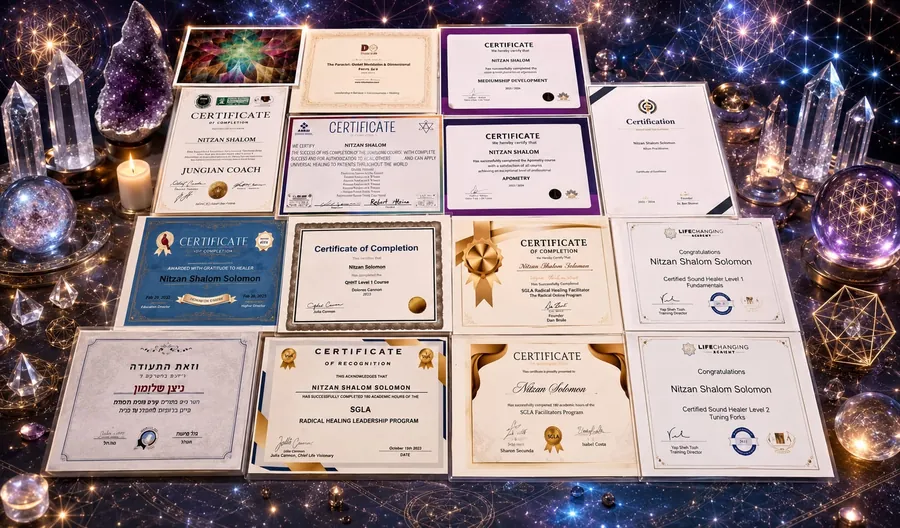
The training took years, and it is worth being honest about why. It was not a plan. Each system I studied answered a question the previous one had left open, and each one raised a new question of its own.
Holistic health taught me the unglamorous layer — sleep, food, movement, stress — which turns out to matter far more often than anything mystical. Jungian coaching gave me a language for the part of a difficulty that is a pattern rather than an event. Radical Healing, taught by a retired Supreme Court judge, was closer to ethics than to technique: it asked what a facilitator is actually responsible for. BQH and QHHT taught me how to hold someone in a deep state without steering them. Breath work taught me when breath helps and, more usefully, when it does not. Sound reaches people whom words have stopped reaching.
Apometry, Arcturian energy work, lead cleansing, mediumship — each of these is a framework with its own vocabulary, and I hold them as working languages rather than as literal descriptions of reality. What they share is a way of paying attention.
Why Accumulate So Much
The honest answer is that I could not find one system that accounted for everything I was seeing. Every framework I studied explained part of it well and part of it badly, and the parts they explained badly were the parts people kept arriving with.
So the collection is not a display. It is the record of a long argument with myself about what actually helps — and the arguing has not finished.
What Integration Actually Requires
Holding many methods is easy to claim and hard to do well. It requires three things that are rarely mentioned:
- Knowing each one properly. A weekend course does not qualify you to combine anything. Most of these took months or years.
- Knowing when not to use one. The temptation with a large toolkit is to use all of it. The discipline is to use less.
- Being able to say which frame you are in. Psychological, energetic, symbolic and practical are different languages. Pretending they are one thing is where this work goes wrong.
What I Am Still Learning
QHHT Level 2 is in progress. Breathwork practitioner study continues. I read more than I practise, and I change my mind about things — which is uncomfortable to say on a page meant to inspire confidence, and truer than the alternative.
If you want the full record, including what is complete and what is not, it is on the Training & Studies page.

Where to go from here
Begin where you are.
Book a session, or send a message and we’ll find the right starting point together.