Quantum Healing Field
Tower of Babel 2.0: Artificial Intelligence, Digital Identity and the Battle for Human Sovereignty
Are AI, digital identity and brain-computer interfaces changing what it means to be human?
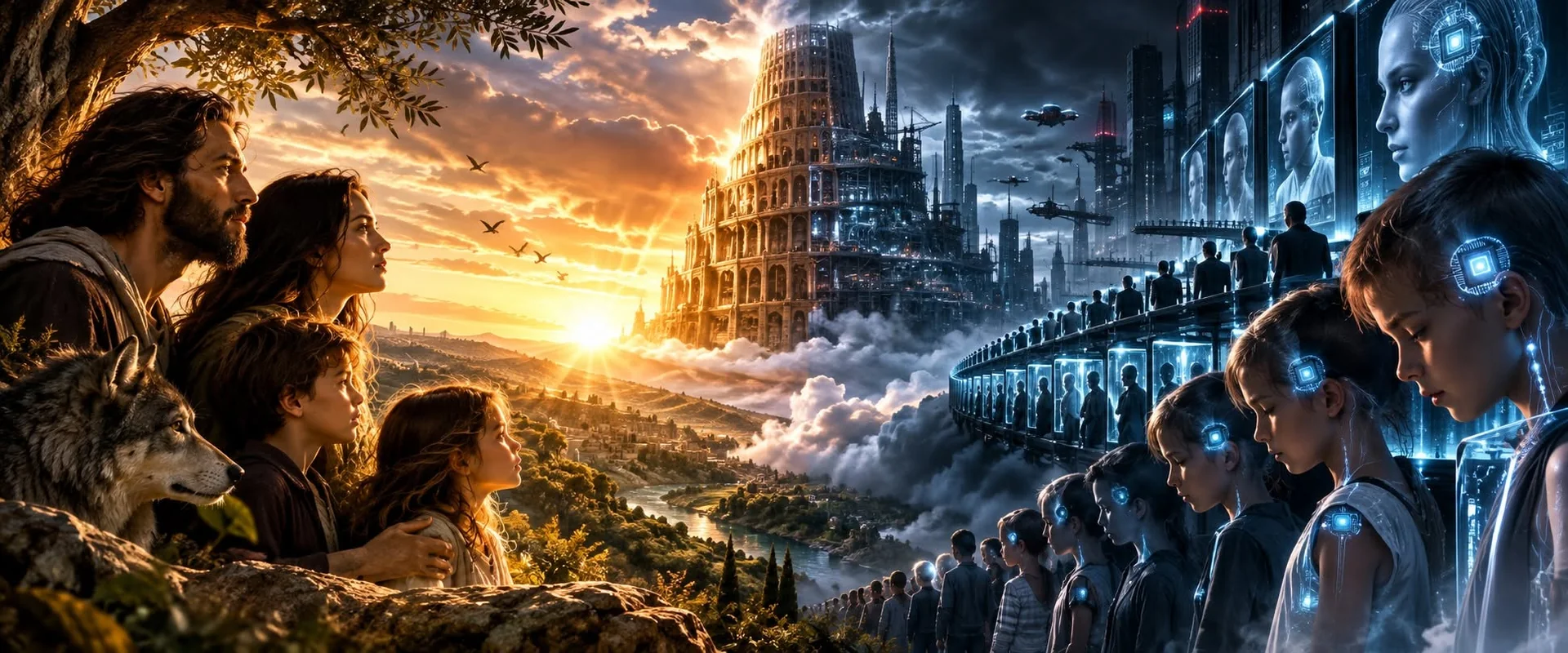
We may be among the last generations who can still remember what the world felt like before the system moved this close to the body, identity and mind.
Not because everyone is about to have a microchip implanted in their forehead.
Relax.
I use artificial intelligence myself. A lot.
The real issue is far more interesting — and far less cinematic.
We belong to a generation that still remembers a world in which not every human action immediately became data.
A world where you could walk down a street without producing a continuous digital trail of location, searches, purchases, heart rate, sleep, relationships, preferences and attention.
A world in which identity was primarily something you lived before it became something a system could authenticate.
That transformation is not necessarily evil.
Much of it is extraordinary.
Technology saves lives.
It connects people.
It democratizes knowledge.
It gives tools and voices to people who previously had neither.
It allows us to accomplish in an hour what might once have taken a week.
But precisely because I use technology, appreciate it and understand its power, I think we need to ask a question that is not technological at all:
What is a human being — and what are we willing to turn one into?
Because the defining struggle of the artificial-intelligence age may not ultimately be humans versus machines.
It may be a struggle over the definition of the human being.
This is not an anti-technology article
Let me make that clear from the beginning.
I am not suggesting we throw our phones into the sea, cover the walls in aluminum foil and move into a cave.
I use AI.
I work online.
I live inside the digital world like almost everyone else.
I see enormous potential in technology for creativity, research, education, communication and even self-reflection.
So the question that interests me is not:
Is technology good or evil?
That is too simplistic.
A hammer can build a home.
A hammer can also break a skull.
The hammer is not the philosophical issue.
The question is:
Who is holding whom?
Does the tool serve the human being?
Or does the human being gradually reorganize their identity, behavior, relationships and consciousness around the demands of the tool?
That is where things become interesting.
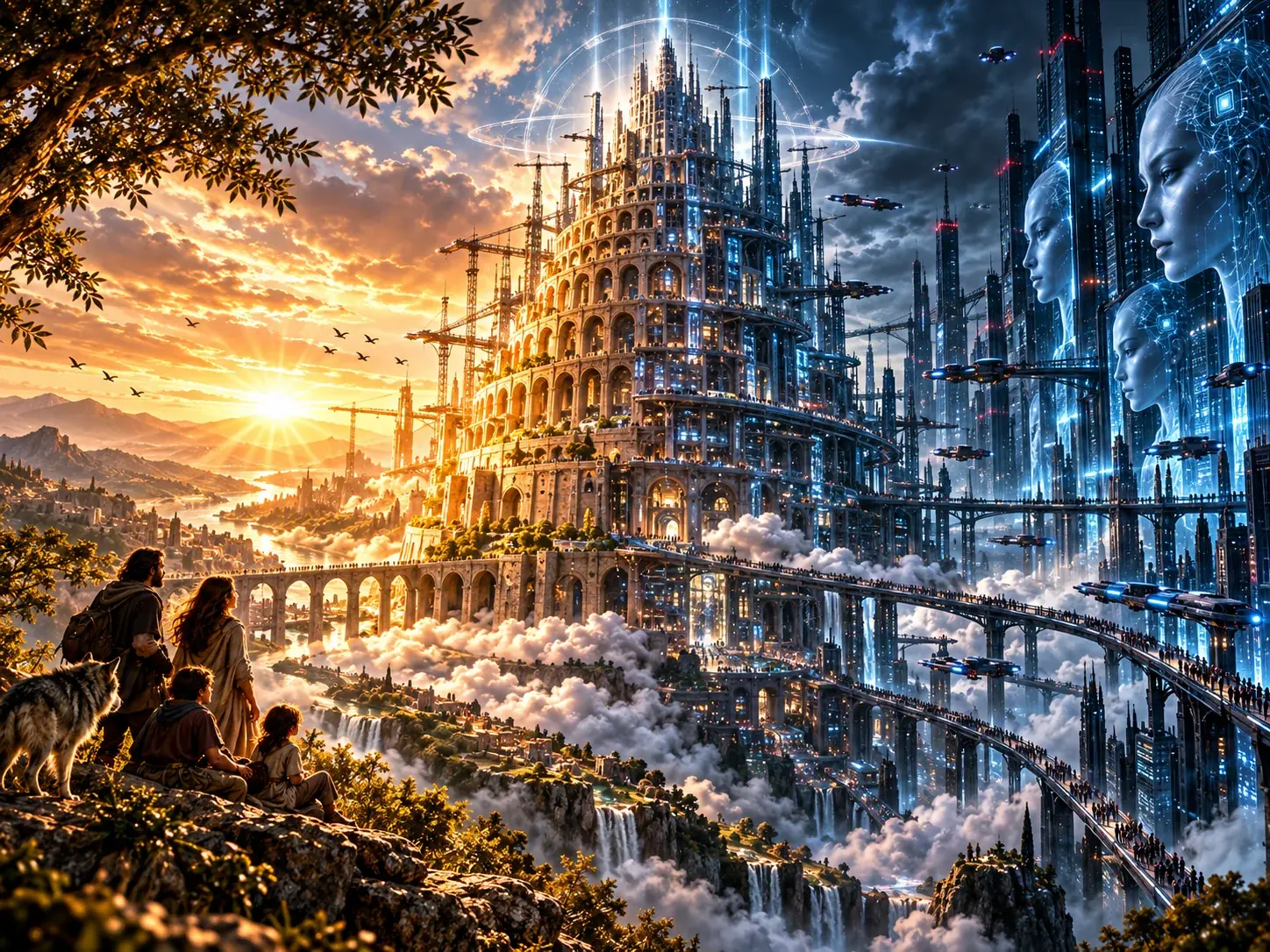
The Tower of Babel never disappeared. Perhaps we simply changed the building materials.
In the biblical story of Babel, humanity is not fragmented.
Quite the opposite.
Humanity is unified.
“One language and the same words.”
People concentrate power, ability and ambition around a single shared project and construct a tower intended to reach the heavens.
I am not presenting this as the only theological interpretation of Genesis.
I am using Babel as an archetype.
And archetypally, what makes the story interesting is that the danger is not chaos.
The danger is absolute uniformity.
One language.
One structure.
One center.
One system.
Once we built towers from bricks.
Today we build clouds.
Networks.
Databases.
Models.
Identification systems.
Recommendation engines.
Digital identities.
Systems capable of classifying us, predicting us and increasingly making decisions that affect us.
That is where the phrase comes from for me:
Tower of Babel 2.0.
Not because I imagine seven mysterious people sitting in a secret room controlling humanity.
Reality is generally much more complicated — and often more interesting — than theories like that.
Babel 2.0 is what happens when more and more dimensions of human existence begin passing through the same digital layer:
Identity.
Money.
Communication.
Work.
Health.
Relationships.
Knowledge.
Entertainment.
Memory.
And now —
thought itself.
That is no longer science fiction.
It is a serious philosophical question.
Digital identity is no longer a futuristic concept
There is no need for conspiracy theories to discuss digital identity.
It already exists.
The European Union, for example, has established a framework for European Digital Identity Wallets, intended to allow citizens and residents to identify themselves and store or present digital documents and credentials.
It is equally important to mention the other side of the story: the European model explicitly emphasizes user control, privacy and selective disclosure.
And that is exactly the point.
The existence of digital infrastructure is not automatically the problem.
The real questions are:
How is it designed?
Who controls it?
What choices remain with the individual?
What information is collected?
How long is it stored?
Who can access it?
And what happens if someone chooses not to participate?
Those distinctions matter enormously.
I am not frightened by a digital card.
I am interested in what happens when we stop asking these questions because something is simply more convenient.
Because convenience is one of the quietest transactions of the digital age.
Scan your face.
Accept the terms.
Allow location access.
Contacts.
Microphone.
Camera.
Health.
Sleep.
Heart rate.
Habits.
Each permission may make perfect sense on its own.
But when all the points are connected, a different picture begins to appear:
The human being becomes increasingly legible to the system.
The question is whether the human being is becoming equally legible to themselves.
We already wear the system
Long before implants, many of us already move through the world covered in sensors.
Phones.
Smartwatches.
Smart rings.
Fitness trackers.
Health applications.
Sleep monitoring.
Movement data.
Heart rate.
Menstrual-cycle data.
Nutrition.
Mood.
Location.
Again:
This is not automatically bad.
Much of this information can be genuinely useful.
But it is also deeply intimate.
Health apps and wearable devices can collect information that once existed almost exclusively inside conversations between individuals and healthcare professionals.
Location data can reveal far more than coordinates.
Where someone worships.
Where they seek medical care.
Whom they visit.
Where they sleep.
Where they spend their nights.
Where they go when nobody else is supposed to know.
Privacy concerns in this environment are not fantasy.
But neither are they proof of one centralized global conspiracy.
They are simply the predictable consequence of a world in which increasingly intimate dimensions of the body and behavior become data.
And what happens when technology literally enters the body?
This is where precision becomes especially important.
Implantable brain-computer interfaces are no longer confined to science fiction.
Human trials already exist.
Neuralink, for example, began testing an implantable brain-computer interface in human participants as part of research aimed primarily at helping people with paralysis control external devices using neural signals.
That matters.
Because giving a person with paralysis greater independence is not the destruction of humanity.
Quite possibly, it is an extraordinary expression of human ingenuity serving human dignity.
And once again we arrive at the same question:
Who is master and who is tool?
Technology that restores human capacity can be a blessing.
Technology that expands freedom can be a blessing.
Technology that makes communication possible where communication was previously impossible can be a blessing.
But the existence of such technology also means that we should begin discussing boundaries before those boundaries become urgent.
What happens if neural interfaces eventually move beyond restoration into enhancement?
Who owns neural data?
Could brain signals one day become another category of commercially valuable information?
Where does privacy begin when technology can interface directly with the nervous system?
What remains exclusively ours?
These are not prophecies.
They are questions.
And sometimes the questions a civilization is willing to ask early determine which problems it avoids later.
Further Perspective | Gregg Braden
One of the people I have learned from over the years is Gregg Braden, whose work frequently explores the intersection of science, technology, consciousness and what it means to remain fully human during periods of rapid change.
In the following video, Braden offers his perspective on the 2030 conversation, emerging body technologies, brain-computer interfaces and the evolving relationship between humans and machines.
I am including it here not as “proof” of every claim made in this article, but as additional material for exploration. Some of the subjects discussed relate to technologies that already exist, while others involve interpretation and projections about the future.
As always: listen, investigate, cross-check — and think for yourself.
The Sitra Achra rarely introduces itself as the Sitra Achra
Now we return to our language.
In Kabbalah, Sitra Achra literally means “the other side.”
The side of separation.
The side where the vessel forgets its relationship to the source.
I do not think the most useful way to understand technological danger is through childish images of machines becoming demons.
A computer is not Satan.
An algorithm is not a spirit.
But a system can become a kelipah — a shell — when it begins to conceal the very thing it was originally created to serve.
And the shell rarely announces itself by saying:
“Give me your soul.”
It says:
Give me a little convenience.
Just one more permission.
Stay connected.
Let me organize it for you.
Let me choose for you.
Let me write for you.
Let me think for you.
Let me remember for you.
Let me recommend what you should love.
What you should read.
What you should watch.
Whom you should date.
What you should buy.
What you should believe about what happened today.
Every one of those functions can be useful.
I use some of them myself.
The problem begins when we no longer know:
Where does the tool end — and where do I begin?
Light and vessel: perhaps this is the entire technological question
Kabbalah repeatedly returns to the relationship between light and vessel.
The vessel is not the enemy.
Without a vessel, there is no reception.
No expression.
No manifested world.
Light requires a vessel in order to appear within form.
But the vessel is not the source.
The distortion begins when the vessel starts behaving as though it is.
That is the metaphor I keep returning to when I think about artificial intelligence.
AI is an extraordinary tool.
Sometimes almost absurdly powerful.
I can bring it a raw idea and receive research, structure, possible interpretations, language and analysis.
But if I stop thinking because it thinks —
something has happened.
If I stop creating because it creates —
something has happened.
If I stop distinguishing between an inner truth and a sentence generated beautifully by a model —
something has happened.
The danger is not that the machine became intelligent.
The danger begins when the human being voluntarily abandons the obligation to remain conscious.
Image of God versus image of machine
Genesis contains one of the most radical statements ever written about humanity:
“In the image of God He created him.”
People have debated for thousands of years what precisely *tzelem Elohim* — the image of God — means.
But whatever interpretation one prefers, something profound remains:
A human being is not merely a function.
Human value cannot be reduced to efficiency.
Productivity.
Speed.
Accuracy.
Data output.
Predictability.
And this is where I think the technological age becomes psychologically and spiritually dangerous.
Not necessarily because machines will become human.
But because humans may begin evaluating themselves according to the characteristics of machines.
Faster.
More efficient.
More connected.
More measurable.
More productive.
More optimized.
More predictable.
More available.
But a human being is not a badly optimized computer waiting for an upgrade.
There is value in slowness.
In wandering.
In doubt.
In silence.
In contradiction.
In imagination.
In dreams.
In heartbreak.
In the question that still has no answer.
In the strange moment when something inside us seems to know before we can produce the data explaining why.
I call that intuition.
Someone else may call it nervous-system processing, unconscious pattern recognition, accumulated experience or implicit cognition.
For this particular argument, the label matters less than the capacity.
I simply do not want us to lose the ability to listen.
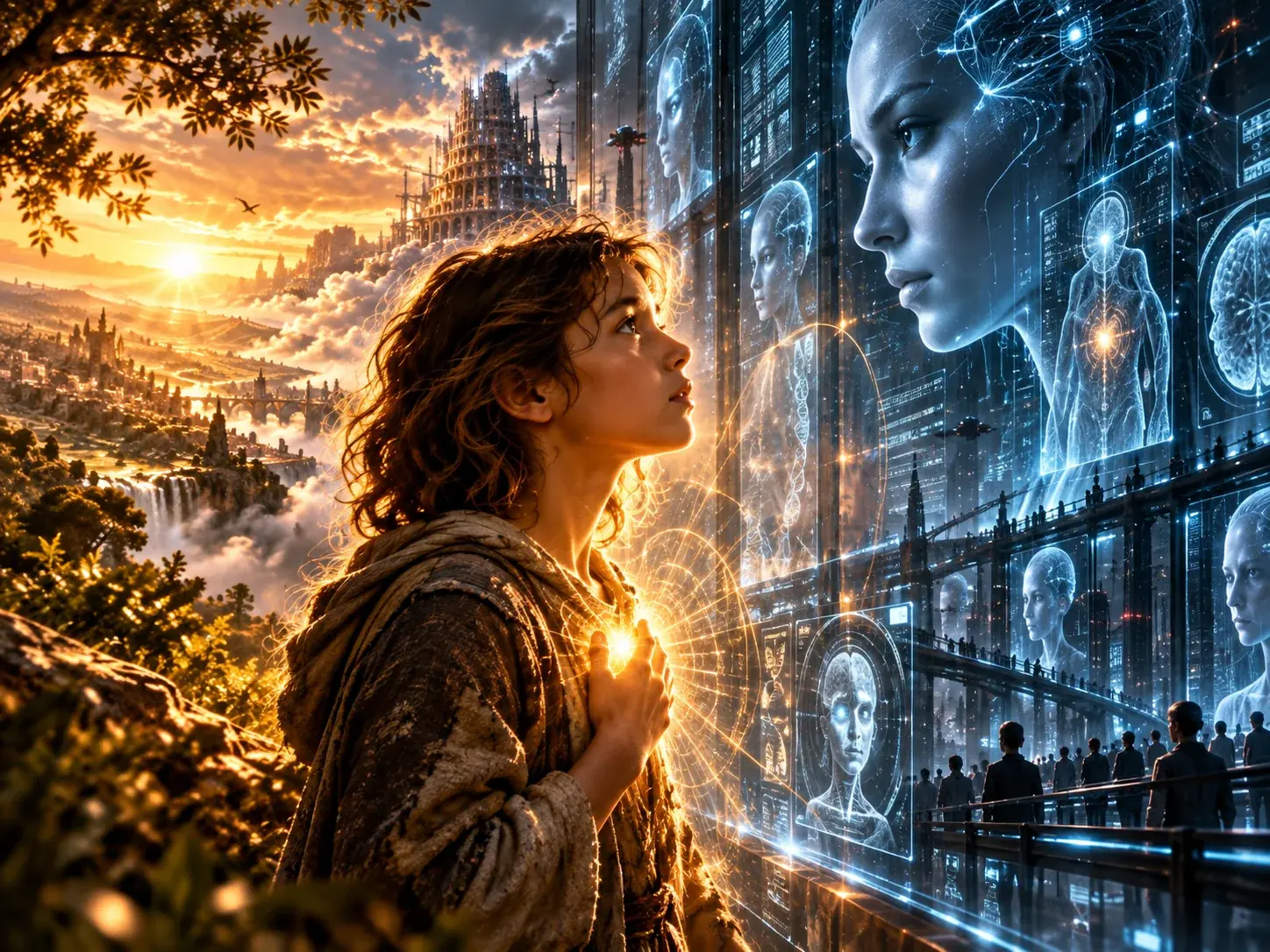
The soul is inconvenient for systems built around measurement
Systems like variables.
Numbers.
Categories.
Scores.
Predictions.
Probabilities.
Locations.
Segments.
Behavior.
Things that can be measured are easier to manage.
Human beings, however, refuse to behave neatly inside tables.
Love is inconvenient.
Compassion is inconvenient.
Conscience is inconvenient.
Creativity is inconvenient.
Faith is inconvenient.
Sacrifice is inconvenient.
A person willing to lose something valuable because they believe something else is morally right becomes difficult to model if the model assumes that human beings always respond predictably to incentives.
This is not an argument against science.
Quite the opposite.
I want better data.
Better science.
Better systems.
Better AI.
But I also want us to remember:
What can be measured is not necessarily everything that exists.
And you do not have to believe in a religious concept of the soul to understand the point.
Replace “soul” with:
Human dignity.
Subjectivity.
Conscious experience.
Agency.
Interior life.
Personhood.
Even secular discussions about AI ethics increasingly return to precisely these questions: human dignity, privacy, autonomy, accountability and meaningful human oversight.
Their language may be different.
In our language:
Do not forget who is the master and who is the vessel.
The real battle is not humanity versus AI
I actually think that framing may distract us.
Humans versus AI.
Robots versus humanity.
Machines taking over.
It makes entertaining cinema.
But the more immediate struggle is happening somewhere much closer.
Every time we let an algorithm choose where we could have chosen.
Every time recommendation replaces discovery.
Every time we ask a system to formulate an opinion we have never stopped to determine whether we actually believe.
Every time human contact is replaced by another hour of scrolling.
Every time we say:
“The system says so, therefore it must be true.”
The deeper conflict is between two different ideas of what a human being is.
One says:
A human being is an extremely complex biological information system. Collect enough data and eventually we will be able to predict, optimize, direct and improve it.
The other says:
Yes, human beings are biological.
But they cannot be reduced to biology alone.
There is body.
There is brain.
There is psychology.
There is history.
There is culture.
There are relationships.
There is meaning.
And there remains something we still cannot fully explain:
subjective experience.
Awareness.
The feeling of being “I.”
And perhaps —
soul.
Conscious sovereignty is not resistance to progress
The word I keep returning to is sovereignty.
Not sovereignty in the sense of disconnecting from civilization.
Sovereignty as the recognition that there is an inner territory that does not automatically need to be outsourced.
Not every question needs to be asked of a machine.
Not every moment of boredom needs to be filled.
Not every heartbeat needs to be measured.
Not every moment needs to be photographed.
Not every thought needs to be uploaded.
Not every part of human life must become data.
And not everything a system *can* know about you necessarily needs to be known by it.
Technological capability and moral entitlement are not the same thing.
That distinction may become one of the defining debates of the coming decades.

Seven questions to ask before allowing another system into your life
I am not searching for technological purity.
I am interested in technological consciousness.
So before adopting another application, AI tool, wearable or connected system, I think these questions are worth asking:
- What does this tool give me — and what does it receive in return?
- What information does it collect, and is all of that information truly required for the service?
- Can I use this tool without becoming dependent on it?
- Does it expand a capacity I already possess — or gradually remove my need to develop that capacity?
- Who is making the final decision: me, or the system's default?
- Does it connect me more deeply to people and reality — or mostly connect me more deeply to a screen?
- If this tool disappeared tomorrow, would something essential in me still know how to function without it?
For me, that is one of the differences between technology as a tool and technology as a shell.
What do we teach children who were born inside the system?
This may be the most important part.
My generation still remembers a “before.”
Before smartphones.
Before the feed.
Before every moment had the potential to become content.
Before recommendation engines became intimately familiar with our preferences.
Children born now do not remember that world.
For them, it never existed.
Our responsibility therefore cannot be to teach them to fear technology.
That would be both ineffective and foolish.
We have to teach them how to use it without disappearing into it.
Teach them to use AI.
But also to write a page without AI.
Teach them to navigate digitally.
But also to lift their eyes and understand where they physically are.
Teach them to search for information.
But also to recognize nonsense.
Teach them how to create an avatar.
But also to know the face behind it.
Teach them to understand followers, views and engagement —
without confusing those numbers with personal worth.
And above all, teach them:
You are not the user.
You are not the account.
You are not the number.
You are not the profile.
You are not your search history.
You are not your heart-rate data.
You are not your location history.
You are not what the algorithm predicts you will do next.
You are the spark within the vessel.
What does any of this have to do with Quantum Healing Field?
For me, the connection is direct.
Quantum Healing Field is not meant to be another place where people escape physical reality into spiritual language.
Quite the opposite.
Any meaningful work with consciousness, intuition, inner patterns and conscious creation should bring us deeper into reality.
It should strengthen our ability to ask:
What do I actually think?
What am I actually feeling?
What am I choosing?
What arises from within me — and what has simply been placed in front of me repeatedly until it began to feel like my own thought?
We live in a world in which external influence is becoming increasingly sophisticated.
Not only advertising.
Feeds.
Algorithms.
Recommendation systems.
Language models.
Digitally amplified social pressure.
In that environment, the capacity to listen inwardly becomes more important, not less.
That is why I do not see intuitive work as an escape from technology.
I see it as part of learning that not every source of authority needs to exist outside ourselves.
We can use artificial intelligence while preserving judgment.
We can use digital systems while maintaining boundaries.
We can enter the future without placing the entire self on the table as the price of admission.
Those who want to explore this territory through intuition, consciousness and conscious creation can continue to Intuitive Channeling & Conscious Creation.
And throughout the Healing Journal, I return to this same question from different directions:
How do we use the tools of the world without allowing those tools to become our identity?
Perhaps this really is Babel 2.0 — but the ending has not been written
I do not know what the world will look like thirty years from now.
And whenever someone tells you with complete confidence that they do —
it is worth asking what they are selling.
We may live with sophisticated brain-computer interfaces.
Digital identity may become as ordinary as a credit card.
Artificial intelligence may become an almost invisible layer inside nearly every part of human life.
Some of today's fears may look ridiculous in retrospect.
Some may look painfully naive.
But we do not need to predict the future perfectly in order to ask the right question.
We need to arrive there awake.
Technology will change.
Interfaces will change.
Systems will change.
Our scientific understanding of consciousness itself may change.
But there is one thing we should not surrender casually:
the right to remain the authors of ourselves.
Do not fear the future.
But do not worship it either.
Do not turn every technological innovation into a demon.
But do not turn every innovation into a god.
Use.
Question.
Examine.
Set boundaries.
Remember.
A machine may become better than me at a thousand different tasks.
It may calculate faster.
Remember more.
Recognize patterns I cannot see.
Write faster.
Search faster.
Perhaps one day it will identify patterns in my own behavior before I consciously recognize them.
And still —
it is the tool.
I am the human being.
Or, if you prefer the older language:
It is the vessel.
You are the spark.
So if one day the world becomes connected through one enormous, beautiful, efficient and almost seamless network —
do not panic.
But do not fall asleep either.
Because the Tower of Babel was never only a story about a very tall building.
It was also a story about what can happen when a human system becomes so total that the people living inside it forget who they are without it.
The future does not necessarily need less technology.
It needs more human beings capable of using technology without becoming an extension of it.
The image of God does not need a software upgrade.
It needs to remember that it is the image.
Frequently asked
Is artificial intelligence dangerous to humanity?
Artificial intelligence is not inherently good or evil. Its risks depend on how systems are designed, deployed and governed. Current concerns include privacy, bias, accountability, transparency, concentration of power and the degree to which meaningful human oversight remains part of important decisions.
What is conscious sovereignty?
Conscious sovereignty is the capacity to maintain independent judgment, identity and inner agency in an environment increasingly shaped by algorithms, digital systems and automated recommendations. It does not require rejecting technology. It requires remaining aware of when a tool is supporting a choice and when it is quietly replacing one.
Does digital identity mean everyone will eventually be controlled by one system?
Not necessarily. Digital identity systems vary greatly, and some are explicitly designed around privacy, selective disclosure and user control. The important questions concern what information is collected, who can access it, what safeguards exist and whether meaningful alternatives remain available.
Do brain-computer implants already exist?
Yes. Implantable brain-computer interfaces are already being studied in human clinical research, primarily for medical purposes such as assisting people with severe neurological or physical disabilities. This is very different from the idea that brain implants are currently being routinely deployed among the general population.
Do smartwatches and health apps collect personal information?
Yes. Depending on the device and application, they can collect information related to movement, heart rate, sleep, location and other health or behavioral indicators. What happens to that data depends on the provider, privacy policy, permissions and applicable regulation.
What does the Tower of Babel have to do with artificial intelligence?
In this article, Babel 2.0 is a metaphor, not a claim that modern technology literally fulfills a biblical prophecy. It represents the possibility of increasingly centralized and standardized human systems becoming so dominant that the system itself begins to matter more than the people it was meant to serve.
Is Quantum Healing Field opposed to artificial intelligence?
No. Technology, including AI, can be enormously useful. The central question is whether it expands human capacity or gradually replaces judgment, creativity, connection and personal responsibility. The aim is not technological rejection, but conscious use.
Where this meets the actual work
- Intuitive Channeling & Conscious CreationSometimes you don’t need another answer — you need enough quiet to…
- Multidimensional Energy & Consciousness WorkNot one technique. Not one script. A session built around what actually…
- Holistic Health · Body, Lifestyle & ConsciousnessLook at the whole person — not only one symptom.

Where to go from here
Begin where you are.
Book a session, or send a message and we’ll find the right starting point together.