Gaia
A streaming library for consciousness, yoga, meditation and the questions that do not have settled answers — thousands of titles, seven days free.
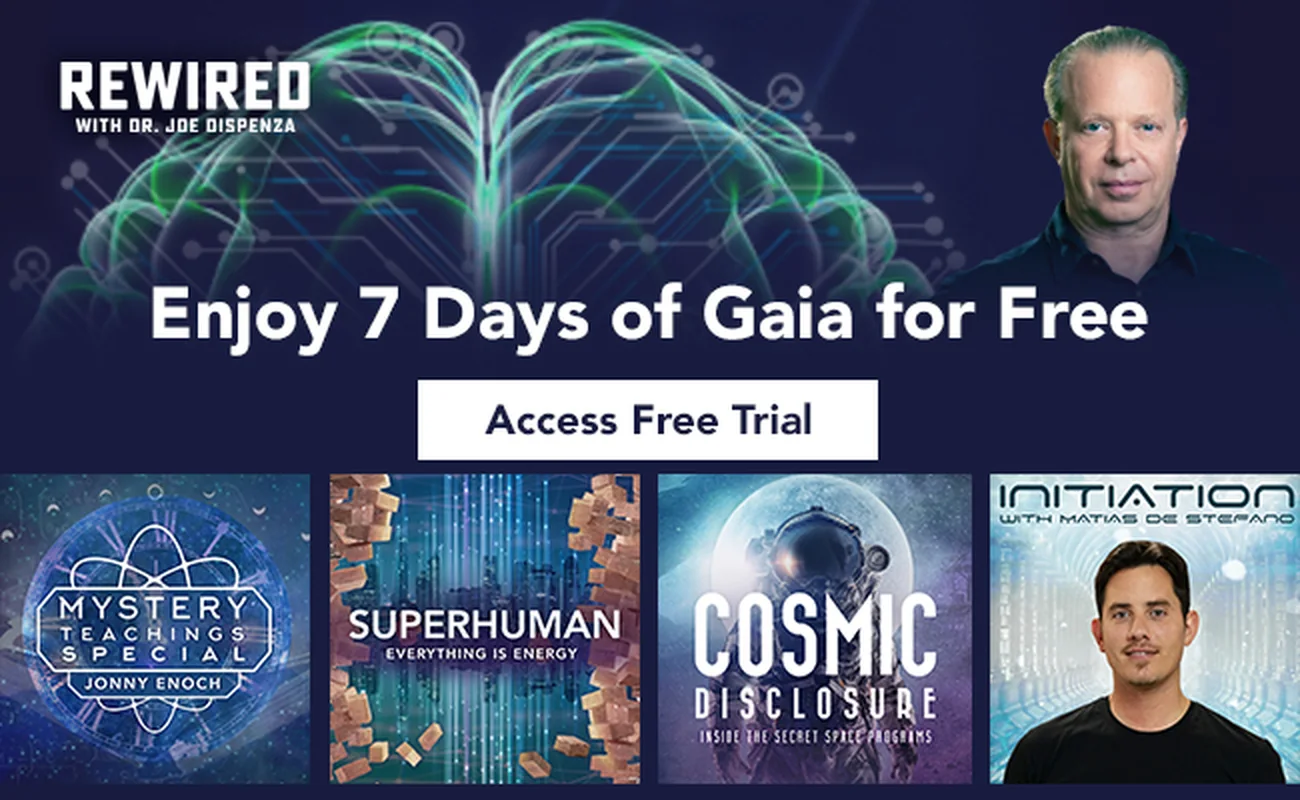
The offer
Seven days of Gaia, free
The full library, at no cost, for seven days — on the monthly and the annual plan. This is the offer Gaia themselves suggest starting with.
The trial becomes a paid subscription unless you cancel. Put a reminder in your calendar for day six — you can cancel whenever you like, including inside the week.
What is included
- Seven days free — the full library, on the monthly and annual plans.
- Thousands of titles — films, series and classes, not a single course.
- On every screen — browser, phone, tablet and television apps.
- $119 a year instead of $13.99 a month — about $9.92 a month paid annually.
- 10% off the Gaia Marketplace — on their courses, events and journeys.
- Gaia+ at $299 a year — the tier with live events and replays, among them The Monroe Institute Conference on 7–8 November 2026.
- Cancel whenever you like — including inside the trial week.
US prices, checked 22 Oct 2026 against Gaia’s own pages. Prices and terms vary by country — check theirs before you decide.
Gaia is a subscription library. Not a course, not a teacher, not a programme with a beginning and an end — thousands of films, series and classes about consciousness, yoga, meditation, healing, and the questions that do not have settled answers.
It is the first thing in Field Picks that works this way, and that changes what I can honestly tell you about it. Everything else here I either took or read closely enough to say something useful. A library of this size cannot be recommended like that, and I am not going to pretend otherwise.
What I can tell you is what kind of library it is: where it is strong, where I would be careful, and how to spend the free week so that by day three you actually know whether it is for you. That is more useful than a list of superlatives anyway.
Why it is here
Because it overlaps with almost everything this site is about, and because that overlap is unusually wide for one subscription. Breath, meditation, consciousness, the body, the long questions about where we come from — they are all on the same shelf here, which is rarely true anywhere else.
And because of what it is for. Not instead of working with someone. A library is where you go to find out what you are drawn to, in your own time, with nobody watching — and that is a genuinely useful stage, especially before you commit to a course or to a practitioner.
I follow Gaia across several subjects rather than having worked through any one series from beginning to end. They are too large for this to be personal, and I would rather say that than imply a closeness that is not there.
What is actually on it
Four broad shelves, and they are not equal. Knowing which is which before you start is most of what makes the free week worth anything.
Yoga, meditation and movement
The oldest part of the catalogue and the most straightforwardly good. Classes sorted by level and by length, teachers you can follow from one class to the next, and enough of it that you are not repeating the same twenty minutes every week.
Consciousness and transformation
Interviews, courses and series with teachers working on attention, states, breath and the mind. This is the shelf closest to what I do, and the reason the subscription is on this site at all.
Ancient civilisations and unexplained history
Archaeology, symbolism, origin questions. Some of it is careful. Some of it moves considerably faster than the evidence does, and it is presented with the same confidence either way.
Speculative documentary
Disclosure, secret programmes, suppressed technology. This is a real and sizeable part of the catalogue, and it is the part I would least want anyone to assume I am vouching for. If that material interests you, it is here in quantity. If it puts you off, know that it shares the shelf with the rest.
How I would use it
Start the free week with one subject, not with the whole library. The catalogue is large enough that browsing it is genuinely disorienting, and a week spent sampling a little of everything tells you nothing at all. Pick the shelf you came for, watch three or four things properly, and you will know by day three.
A few things that make the difference:
- Follow a teacher rather than a topic. Searching a subject returns forty things of wildly different quality. Finding one person whose thinking you trust and watching what they made is how a library like this becomes useful.
- Treat it as a library, not a syllabus. Nothing here is accredited, nothing qualifies you to practise, and the series are not graded or sequenced for you. That is not a criticism — it is what a library is.
- Use the yoga and meditation shelf as the floor. Whatever else you come for, that part is reliable and you can build a weekly habit on it. The rest is reading.
- Put a reminder in your calendar for day six. The trial becomes a paid subscription unless you cancel, and six days is enough time to decide.
Before you subscribe
It is in English. Not partly — the platform, the catalogue and the interface. If English is work for you, a week will not be enough to get value out of it, and I would rather say that here than have you find out on day two.
The trial becomes a paid subscription unless you cancel. Seven days free on the monthly and the annual plan; after that it renews. At the time of writing it is $13.99 a month or $119 a year on Gaia's published US pricing, with a premium tier above that. Prices and terms change and vary by country — check theirs before you decide.
It is education and entertainment, not treatment. Nothing on it is a substitute for medical or psychological care, and nothing on it qualifies you to practise anything.
The catalogue does not tell you which shelf you are on. A careful teacher and a confident speculation arrive in the same frame, with the same production values and the same music. That is worth knowing before you start, because the frame is persuasive and the content varies a great deal.
Who this suits
- You read and listen comfortably in English.
- You want to explore widely before committing to one teacher or one method.
- You already have a practice and want more material to feed it — more classes, more teachers, more length options.
- You like documentary as a way in, and you are able to hold what you watch at arm's length.
- You want a yoga and meditation library you can actually build a weekly habit on.
And honestly: if you want to be taught one thing properly, by one person, with someone answering your questions — a course or a session is the better use of your money, and the rest of this site is full of both.
Where I would start
These are the titles I would open first, and why they are here. I have not watched them all — the line beside each one says why it touches this site, not what it is worth.

Consciousness and transformation
The shelf closest to what I do, and the reason the subscription is here at all.
- Gregg BradenHosts original series there. He is one of the teachers I learn from, and the first thing I looked for.
- Teachings of Ram DassA classic. If you have not met him, it is a good way into everything else.
- RewiredOne of their original series on consciousness and change.
- TranscendenceFrom the same shelf — an original series.
- InitiationFrom the same shelf — an original series.
- Divine ScienceFrom the same shelf — an original series.

Healing, body and mind
Full-length documentary. Some of these names will be familiar.

Energy, field and frequency
The shelf closest to this site’s own language.

Yoga and meditation
The oldest part of the catalogue and the most straightforwardly good. A weekly habit can be built here.

Ancient civilisations and disclosure
The part I would least want anyone to assume I am vouching for. It is there, it is large, and what you do with it is yours.
The Monroe Institute, where my own path began, is listed there with a conference on 7–8 November 2026 in Boulder, Colorado. What your plan includes is worth checking with them.
The offer
Seven days of Gaia, free
The full library, at no cost, for seven days — on the monthly and the annual plan. This is the offer Gaia themselves suggest starting with.
The trial becomes a paid subscription unless you cancel. Put a reminder in your calendar for day six — you can cancel whenever you like, including inside the week.
What is included
- Seven days free — the full library, on the monthly and annual plans.
- Thousands of titles — films, series and classes, not a single course.
- On every screen — browser, phone, tablet and television apps.
- $119 a year instead of $13.99 a month — about $9.92 a month paid annually.
- 10% off the Gaia Marketplace — on their courses, events and journeys.
- Gaia+ at $299 a year — the tier with live events and replays, among them The Monroe Institute Conference on 7–8 November 2026.
- Cancel whenever you like — including inside the trial week.
US prices, checked 22 Oct 2026 against Gaia’s own pages. Prices and terms vary by country — check theirs before you decide.
Common questions
Is it a course?
No. It is a library — thousands of films, series and classes you choose between. Nothing is graded, nothing is accredited, and nobody is expecting you at a particular hour. If you want to be taught one thing properly by one person, a course is the better fit.
What does it cost?
Seven days free on the monthly and the annual plan, then $13.99 a month or $119 a year on Gaia's published US pricing, with a premium tier above that. Checked 21 October 2026. Prices and terms change and vary by country — check theirs before you decide.
Does the free week become a paid subscription?
Yes, unless you cancel before it ends. That is the one thing on this page worth setting a reminder for.
Is it in Hebrew?
The platform, the catalogue and the interface are in English. If English is an effort for you, that is the main reason this might not be worth it.
Can I watch it on a television?
Gaia has apps for phone, tablet and television as well as the browser. Which devices are supported is on their own page and worth checking for yours.
Do you earn something if I subscribe?
Yes — a commission on what a referred member pays, which is why the links on this page are marked as sponsored. It does not change the price you pay, and it is also why the auto-renewal is stated three times on this page rather than nowhere.
Is this instead of working with someone?
No, and I would not suggest it as that. A library is where you find out what you are drawn to. Working with someone is where something actually moves.
The free week
Seven days of the full library, free, on the monthly and the annual plan. It is the sensible way in: a week is long enough to find out whether the shelf you came for is as good as you hoped, and nothing on this page can tell you that as well as watching four things can.
One sentence that matters more than the rest of this page: the trial becomes a paid subscription unless you cancel. Put a reminder in your calendar for day six. If it is for you, do nothing and it continues. If it is not, you have cancelled in time — and the week was still yours.
Some links on this page carry a commission arrangement, marked individually beside each pick. Commission does not decide what is listed here, or in what order.
Where to go from here
-
 All Field Picks
Teachers and courses I have learned from myself. Affiliate links are marked as such.
Open
-
 My own training and studies
Where I trained, with whom, and what each certificate actually covers.
Open
-
 Sessions I offer
Every session I offer — what happens in it, who it suits, and how long it takes.
Open
Begin where you are.
Book a session, or send a message and we’ll find the right starting point together.