Session
Recovery & Rebuilding
COMING SOON · REMOTE 1:1 SUPPORT
There is a point where the question stops being:
“Why can’t I just stop?”
and becomes something deeper:
“What has this been doing for me — and what happens when I no longer need it?”
Addiction is rarely only about a substance or behaviour.
It can become connected with relief, escape, reward, loneliness, shame, relationships, identity, pain, boredom, intensity, self-sabotage, belonging and the simple desire to feel different for a while.
Removing the substance or compulsive behaviour can be essential.
But sometimes that is only the beginning.
Recovery & Rebuilding is a complementary one-to-one support process for people who are moving away from addictive or compulsive patterns and want help understanding themselves, rebuilding their lives and creating something worth moving toward.
This is not detoxification or medical addiction treatment.
It is support for the human being doing the recovering.
I Know Recovery From the Inside
My connection with this work is personal.
I have lived through my own experiences with addiction, compulsive patterns, destructive choices and the complicated process of rebuilding.
That experience is part of what I bring into the room.
Not because my story is your story.
It isn’t.
And not because lived experience automatically makes someone an addiction specialist.
It doesn’t.
I know recovery from the inside.
I also know that lived experience does not make me a medical addiction specialist.
Both of those things can be true.
Beyond “Just Stop”
A useful question is:
What happens immediately before I reach for it?
Stress?
Emptiness?
Loneliness?
Shame?
Anger?
Anxiety?
Celebration?
Rejection?
Boredom?
A relationship conflict?
The feeling that life has become too quiet?
Recovery becomes much more interesting when we stop treating the behaviour as though it appeared from nowhere.
The Pattern Under the Pattern
A substance or behaviour can become part of a larger cycle:
trigger → tension → craving → action → relief → consequence → shame → promise → trigger again
Part of our work may be learning to recognize that structure earlier.
We are not looking for reasons to excuse behaviour.
We are looking for places where choice can become larger.
Shame Does Not Build a Life
Accountability matters.
Denial does not help recovery.
But neither does turning your entire identity into:
“I am a failure.”
We can take what happened seriously without allowing the worst period of your life to become your permanent name.
Who Are You Without It?
Sometimes relapse prevention is not only about learning how to resist something.
It is about creating enough life that returning to the old pattern becomes less compelling.
Rebuilding the Ordinary
Sleep.
Food.
Movement.
Morning routines.
Work.
Money.
Cleaning your environment.
Keeping commitments.
Returning messages.
Spending time with people who are good for you.
Creating something.
Going outside.
Learning how to tolerate a quiet Tuesday without needing to turn it into an event.
These things can become foundations.
Nervous System, Breath & Regulation
My broader training includes breathwork, meditation, relaxation and nervous-system-oriented practices that may sometimes support the process.
These can help create a little more space between impulse and response.
But I do not use breathwork or meditation as magical substitutes for addiction treatment.
Relationships & Recovery
Addiction rarely exists completely outside relationships.
Some relationships support recovery.
Others continually pull us back toward an older version of ourselves.
My work around toxic relationships, boundaries and narcissistic dynamics can therefore become relevant here as well.
The Jungian Lens
My training as a Certified Jungian Coach also informs the way I approach recovery.
Jungian ideas such as the Shadow, Persona, archetypes and individuation can be especially useful when the addictive pattern has become entangled with identity.
The goal is not to become a person with no shadow.
It is to become less controlled by what remains unconscious.
The Persona of “I’m Fine”
Addiction often learns how to wear a very convincing mask.
Recovery often requires the opposite movement:
less performance.
More truth.
Meaning
My wider studies are also influenced by Viktor Frankl’s emphasis on meaning and responsibility.
Eventually another question has to appear:
What am I staying for?
Recovery needs somewhere to go.
Spirituality Without Escaping Reality
Meditation, prayer, forgiveness, connection, ritual and meaning may matter.
But a meditation cannot make a dangerous withdrawal medically safe.
Channeling cannot replace psychiatric care.
Energy work cannot undo the pharmacology of physical dependence.
Grounded spirituality means knowing when the appropriate tool is a doctor, addiction professional, rehabilitation program or emergency service.
What We May Work With
– addictive and compulsive patterns – triggers – cravings and the cycle around them – shame and guilt – identity – routines and structure – rebuilding trust in yourself – self-sabotage – boundaries – toxic relationships – codependent dynamics – loneliness – emotional regulation – fear of relapse – rebuilding after relapse – meaning and purpose – shadow work – Jungian archetypal patterns – meditation – appropriate breath and grounding practices – holistic lifestyle support – reconnecting with creativity and pleasure – creating a future that is larger than recovery itself
Supporting Recovery Alongside Professional Care
This service can also work as a complementary layer alongside established recovery support.
That may include people already working with: – addiction physicians – psychiatrists – psychologists or psychotherapists – rehabilitation programs – recovery groups – peer-support communities – sponsors or mentors – other qualified addiction professionals
What This Service Is Not
I do not provide medical detoxification.
I do not manage withdrawal.
I do not prescribe or alter medication.
I do not diagnose Substance Use Disorder or other psychiatric conditions.
I do not provide emergency addiction services.
I do not advise someone with physical dependence to abruptly stop alcohol, benzodiazepines or other substances where withdrawal may be medically dangerous.
If medical detoxification or psychiatric assessment is needed, that comes first.
This Is Also for the Rebuilding Stage
You do not need to be in immediate crisis to benefit from recovery-oriented support.
Maybe you stopped months ago.
Maybe years ago.
But something still feels unfinished.
You changed the behaviour.
Now you want to change the life around it.
Availability
COMING SOON
Recovery & Rebuilding will initially be offered as remote one-to-one complementary support once the professional insurance and practice framework for Quantum Healing Field are complete.
Recovery & Rebuilding provides coaching, education, reflective support and complementary wellbeing guidance. It is not medical detoxification, addiction medicine, psychotherapy, psychiatric treatment or emergency care. Withdrawal from alcohol, benzodiazepines and some other substances can be medically dangerous and should be assessed and managed by appropriately qualified healthcare professionals. If you may be at risk from withdrawal, overdose, severe intoxication, self-harm or another acute medical or psychiatric emergency, seek immediate professional or emergency assistance.
—
SESSIONS OVERVIEW — RECOMMENDED INTRO
Work With Me
Different doors. One intuitive approach.
You do not need to choose a modality because its name sounds impressive.
Each service below is a different doorway into the Field. Some are structured methods with their own framework. Others are more flexible and may draw from several parts of my training.
If you are not sure where to begin, use Where Are You Now? or simply explore the service that speaks to you.
All initial services are Coming Soon while the professional practice and insurance framework is completed.
Most will open first as remote sessions.
QHHT® will open later and in person.
Display all service cards here.
—
ABOUT — COPY FRAMEWORK
More Than a Collection of Methods
The Human
My path into this work did not begin with a certificate.
It began with life — difficult chapters, relationships, addiction, mistakes, searching, rebuilding and questions that would not leave me alone.
For years I kept returning to the same territory:
Why do we repeat patterns we know are hurting us?
Why can the mind understand something while the body continues doing something else?
Why do some experiences change us in a moment while other lessons take years?
What is consciousness?
What is intuition?
What is healing?
And what happens when psychological, spiritual, energetic and very practical human realities are allowed to exist in the same conversation?
The Seeker
That search became study.
Holistic health.
Energy work.
Channeling.
Multidimensional systems.
Regression-oriented methods.
Jungian psychology.
Breath.
Sound.
Meditation.
Consciousness.
Radical Healing.
Natural health.
And many teachers, traditions and frameworks that do not always agree with one another.
I do not need them to agree.
Different maps can reveal different parts of the territory.
The Practitioner
What I eventually understood is that learning more methods did not make me want to turn people into protocols.
It did the opposite.
The more I studied, the clearer it became that two people can arrive with the same question and need completely different experiences.
So my work is intuitive and integrative.
I listen first.
Then we work with what belongs.
I Am Not My Certificates
The certificates matter.
They represent study, discipline and teachers I respect.
But they are not the story.
They give me tools and frameworks.
Related work
Recovery rarely stands alone. Relationships are usually part of the picture, which is where relational dynamics comes in. The nervous system needs its own attention — see breath and sound and holistic health. Some of why I work this way is in my own story.
Relevant Training
The background behind this work
-
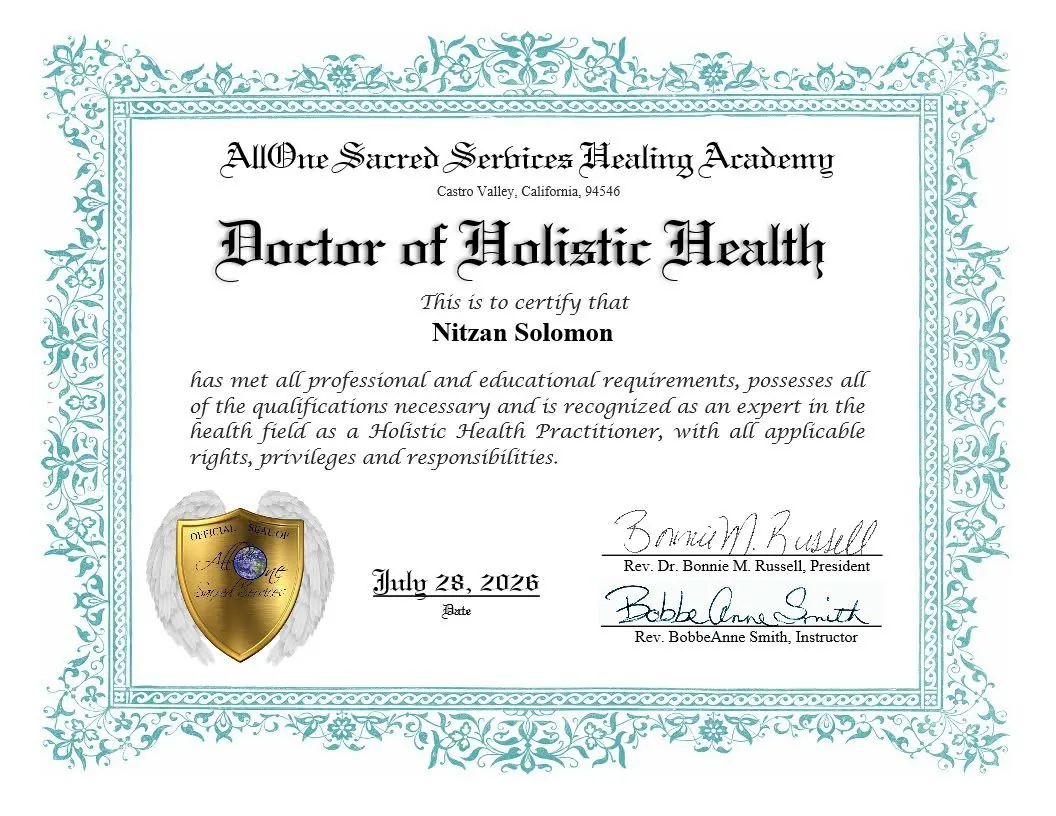
Doctor of Holistic Health (DHH)
AllOne Sacred Services Healing Academy Rev. Dr. Bonnie M. Russell · Rev. BobbeAnne Smith
A broad grounding in holistic health — anatomy, nutrition, herbs and lifestyle — which is the practical, least mystical layer underneath everything else.
A holistic-health credential. Not a medical degree, and not a licence to practise medicine.
-
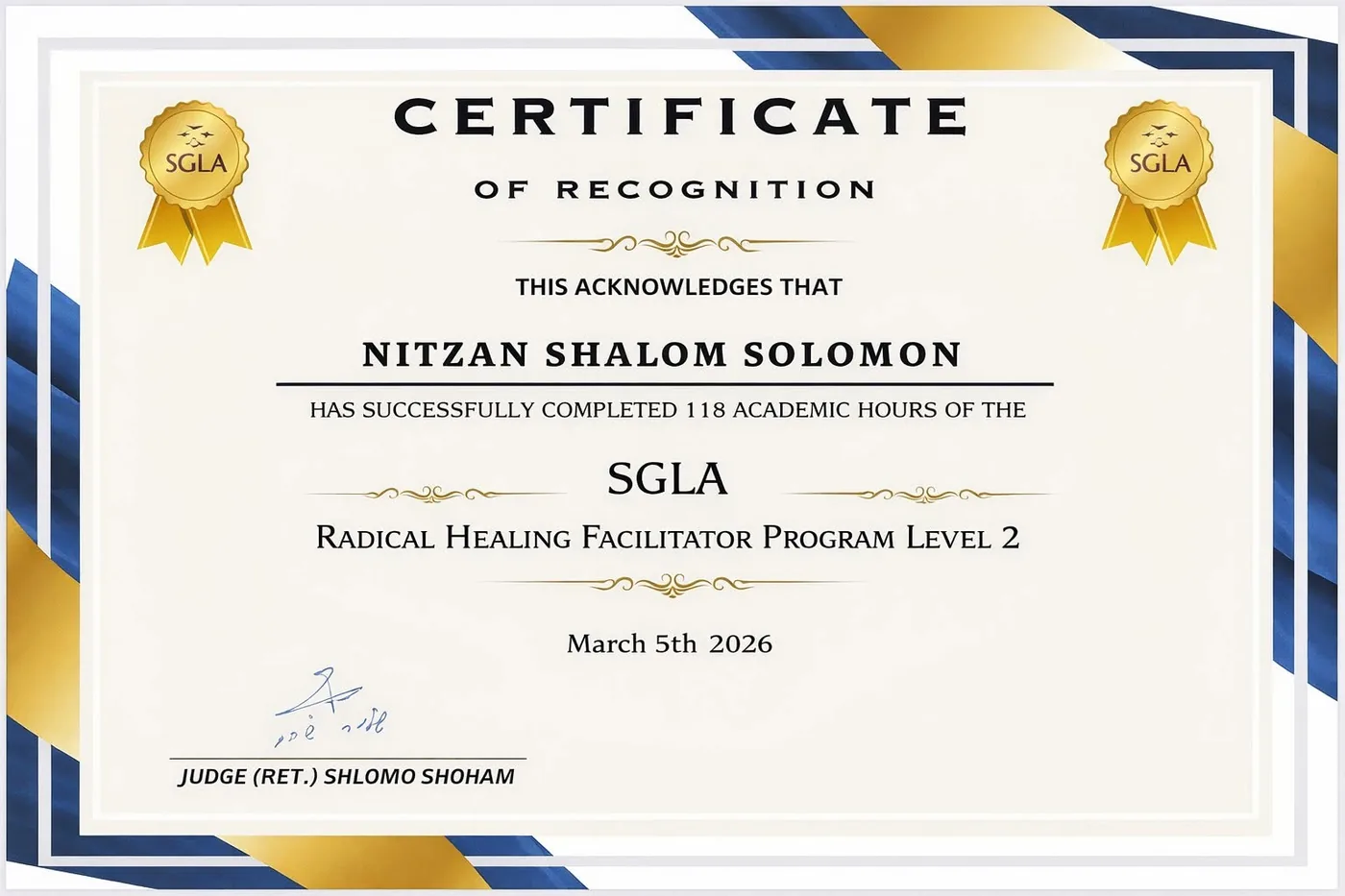
Radical Healing Facilitator — Level 2
SGLA Judge (ret.) Shlomo Shoham
Facilitation of Radical Healing — how a group process is held, and where the facilitator's responsibility begins and ends.
-
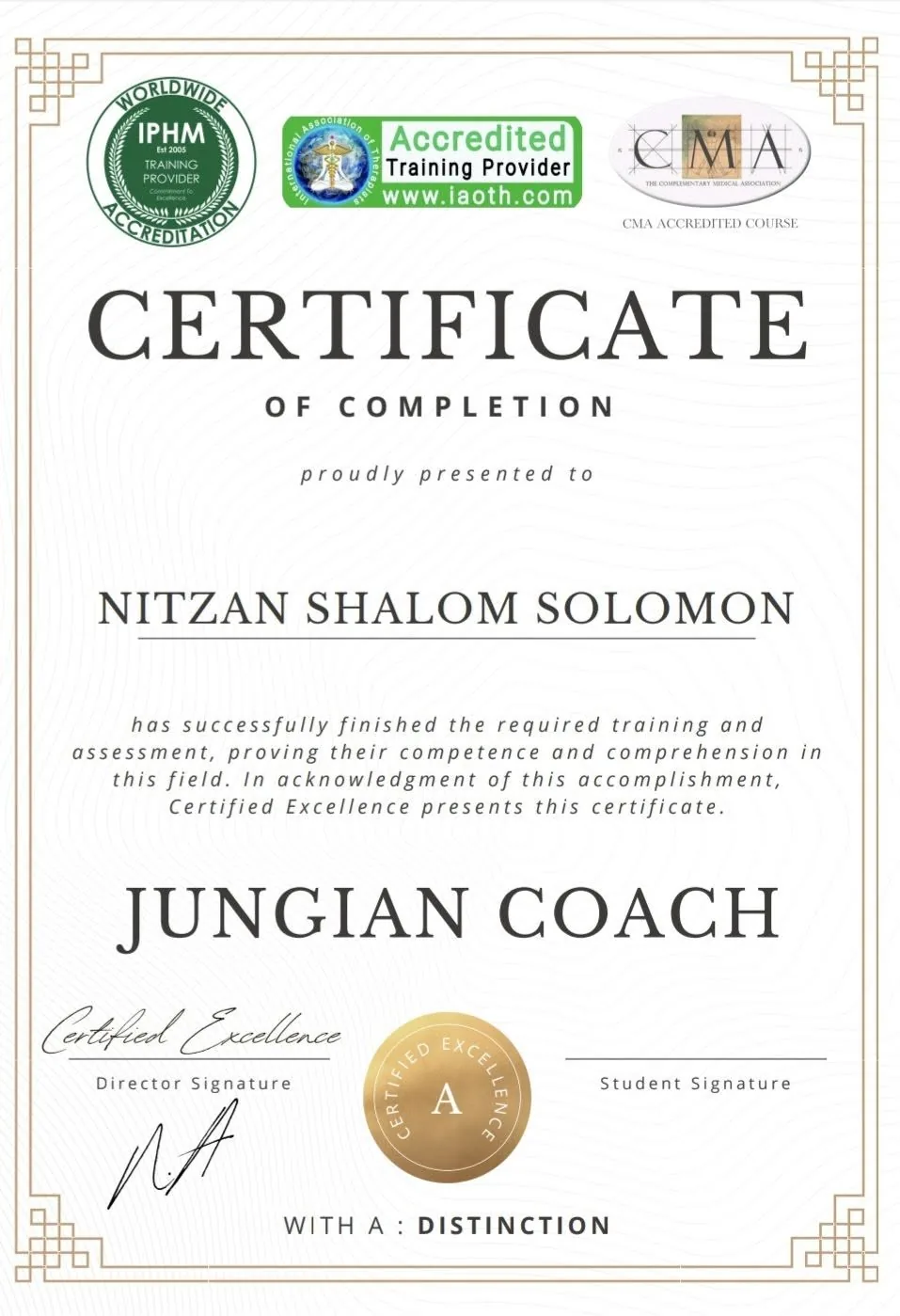
Certified Jungian Coach
Certified Excellence
Shadow, persona, archetype and individuation — the frame I use when someone's difficulty is a pattern rather than an event.
Coaching training in Jungian frameworks. Not a psychotherapy qualification.
Common questions
Is this a substitute for a recovery programme?
No. If you are in a programme, stay in it. This can sit alongside as a place to think about what comes after the immediate crisis.
Do I have to be clean or sober to work with you?
Not necessarily, but I will be honest if I think you need clinical or medical support first, and I will say so early rather than late.
Why do you understand this?
Because I have rebuilt a life myself. That is lived experience, not a clinical qualification, and the difference matters.
What if I relapse?
It is common and it is not a moral failure. It also is not something I treat — that is where appropriate professional support belongs.
How is this different from therapy?
Therapy often works on why. This works more on what now — routine, meaning, boundaries, and what a rebuilt day actually looks like.
I have tried before and it did not hold. Why now?
Maybe it will not, and I am not going to promise otherwise. What can change is the honesty of the starting point.


