Reincarnation Under Scientific Scrutiny: Ian Stevenson, Twenty Cases, and the Mystery of Consciousness
For decades, psychiatrist Ian Stevenson investigated children who claimed to remember previous lives. An in-depth examination of twenty extraordinary cases, the scientific criticism, memory, identity, and the enduring mystery of consciousness.
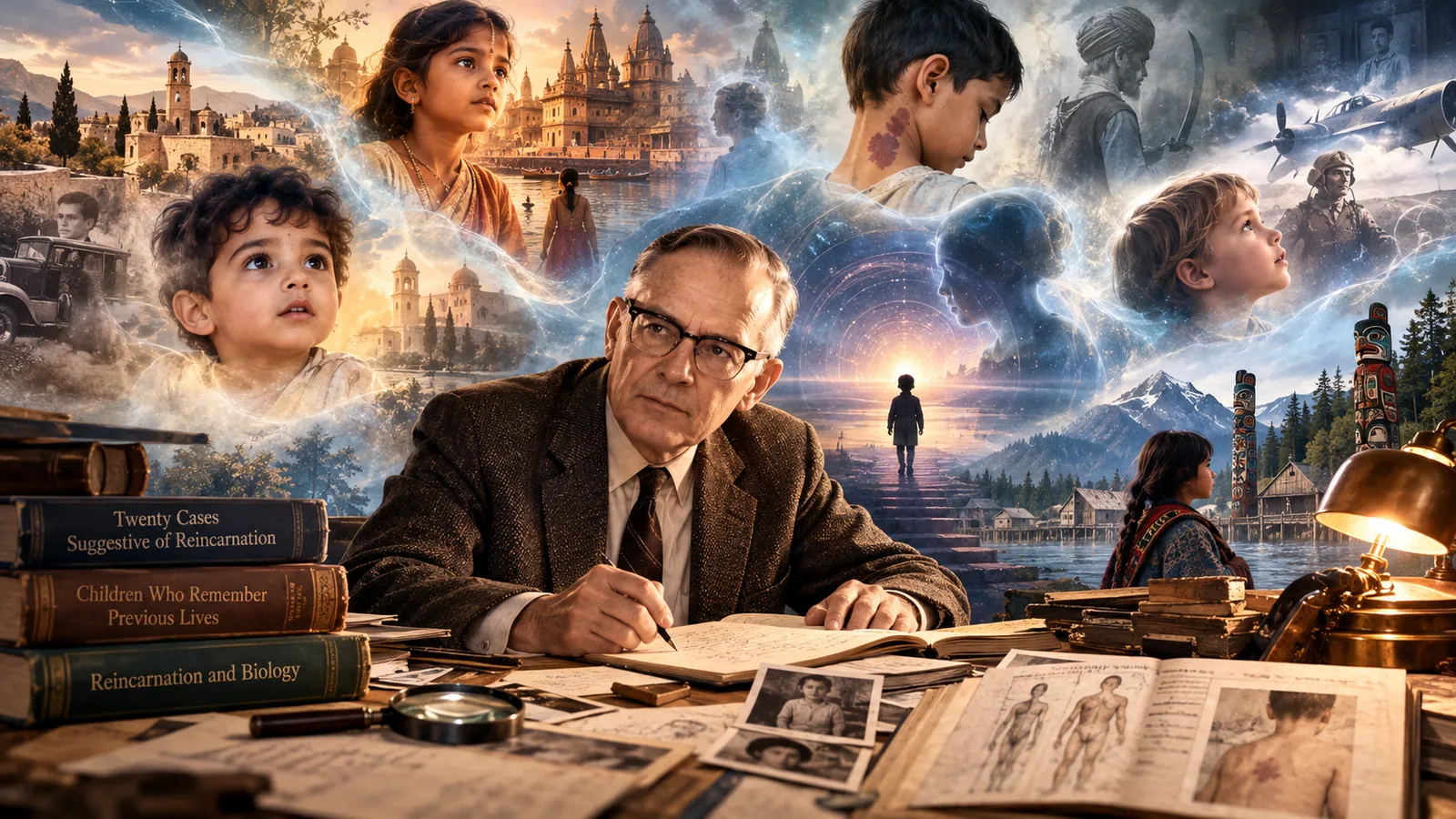
Does human memory begin at birth, or is the body merely one chapter in a much larger story of consciousness? For decades, psychiatrist Professor Ian Stevenson investigated children who claimed to remember previous lives. His research did not prove reincarnation, but it produced an extraordinary body of documentation that continues to challenge assumptions, provoke criticism, and raise fundamental questions about memory, personal identity, and the nature of consciousness.
Some questions have accompanied humanity for thousands of years, yet they seem remarkably resistant to age. What happens to consciousness when the physical body dies? Is memory exclusively a product of the brain, or could certain aspects of identity, personality, and human experience persist beyond the boundaries of biological life?
Religions, mystical traditions, philosophers, and natural scientists have approached these questions from very different directions. Some have described an immortal soul. Others have proposed cycles of birth, death, and rebirth. Still others have understood existence as an ongoing process through which consciousness takes on different forms.
During the twentieth century, however, something interesting began to happen. Alongside religious and philosophical speculation, researchers started examining reports from people — particularly young children — who claimed to remember events from lives they had apparently never lived.
Stevenson was not conducting rituals to contact departed souls, nor was he attempting to demonstrate religious doctrine through scientific terminology. His question was considerably more specific. When a young child describes a deceased person they supposedly could not have known, can the statements be documented, the deceased individual identified, and ordinary channels through which the information might have been acquired reasonably excluded?
It is a less spectacular question than claiming to have proven the immortality of the soul. Scientifically, however, it is far more interesting.
If consciousness and autobiographical memory depend entirely upon the functioning brain, then these reports must be explained through memory formation, learning, social influence, imagination, coincidence, or reporting errors. If those explanations appear insufficient in particular cases, that does not automatically establish reincarnation. It means that an unusual phenomenon remains to be investigated.
That distinction lies at the very heart of Stevenson’s work.
The psychiatrist who brought reincarnation into the research files
Ian Stevenson was born in 1918 and died in 2007. A physician and psychiatrist, he became a professor at the University of Virginia and served for a period as chairman of its Department of Psychiatry.
In 1960, he published a literature review identifying 44 reports that he considered worthy of further investigation, involving people who claimed to remember previous lives. Some reports included detailed statements about deceased individuals whose families supposedly had no previous relationship with those of the children making the claims.
Rather than remaining within theoretical discussion, he began traveling to India, Sri Lanka, Lebanon, Brazil, and other locations to investigate the reports personally. He interviewed families, documented statements, examined available medical records, compared behavioral characteristics, and attempted to reconstruct the circumstances in which the children’s accounts had emerged.
He later established a specialized research unit at the University of Virginia, eventually developing into what is now known as the Division of Perceptual Studies.
Stevenson was certainly not the first person to become interested in reincarnation. His major contribution was methodological. He attempted to transform spontaneous personal accounts into documented cases that could be investigated, compared, criticized, and reconsidered.
He distinguished between what witnesses reported, what investigators could independently establish, what remained unclear, and what might be explained through ordinary means. Not always successfully. Not without weaknesses. And certainly not beyond criticism. Nevertheless, the systematic nature of his work was unusual for the field at the time.
He did not call his most influential early book *Twenty Cases Proving Reincarnation*. He called it **Twenty Cases Suggestive of Reincarnation**.
The difference between suggestion and proof is fundamental. Stevenson understood that distinction.
Twenty Cases Suggestive of Reincarnation: why the book became a landmark
First published in 1966, the book presented twenty investigations selected to illustrate different characteristics of what Stevenson called reincarnation-type cases. The cases came from India, Ceylon — present-day Sri Lanka — Lebanon, Brazil, and the Tlingit communities of Alaska.
They were not selected because all twenty possessed equally strong evidence. Rather, they demonstrated a variety of recurring features: children reporting unfamiliar names and places, expressing emotional attachments to other families, describing apparently unexplained fears, displaying unusual behaviors, or exhibiting birthmarks that investigators attempted to compare with injuries sustained by deceased individuals.
The book also revealed a serious methodological difficulty. In many cases, Stevenson arrived only after the child’s family had already contacted the family of the person whose life was supposedly remembered. Once that contact occurred, establishing precisely who knew what — and when — became much more difficult. Researcher James G. Matlock highlighted this issue in his 2011 historical assessment.
That limitation matters because information can travel between people through ordinary channels, sometimes without anyone deliberately attempting to mislead an investigator. Even so, several cases remain historically significant because of the particular circumstances in which the claims were documented.
Imad Elawar: the Lebanese child who remembered another life
One of the better-known cases investigated by Stevenson involved Imad Elawar, a young boy born into a Druze family in Lebanon.
From an early age, Imad reportedly spoke about people, places, and events that did not appear to belong to his immediate family’s history. He mentioned names, described unfamiliar circumstances, and expressed strong emotions toward details that seemed unrelated to his own life.
According to the investigation, Imad repeatedly expressed great happiness about being able to walk. The deceased man eventually associated with some of his statements had suffered from a serious illness that left him bedridden during the period preceding his death. Imad also displayed a fear of large vehicles, which investigators associated with accidents involving the deceased man and his relatives.
What makes this case particularly important is that Stevenson documented a substantial portion of the child’s statements before the deceased individual was identified. Statements recorded before investigators discover a possible match are less vulnerable to retrospective adjustment than statements reconstructed afterward.
Yet even here, the evidence remains disputed. Critics have questioned the interpretation of particular names, family relationships, and supposed correspondences. The case cannot legitimately be presented as proof that Imad was the deceased man reborn.
It does, however, demonstrate why Stevenson considered early documentation so important. He was attempting to establish what the child had actually said before investigators knew whose life might fit the story. That is the difference between examining an unusual claim and simply believing it.
Swarnlata Mishra: a child who recognised people she had never met
According to the reports, Swarnlata was approximately three and a half years old when she traveled with her family through a town unfamiliar to her and began speaking about a house where she claimed to have lived before.
She subsequently described another family, relationships, places, and details of everyday life that appeared to correspond with a woman who had died several years before her birth. Her father and another investigator recorded some of her statements. A deceased woman whose life matched many of the reported details was later identified.
When Swarnlata met members of that woman’s family, she reportedly recognized numerous people and places. In some instances, she was said to have correctly identified individuals despite attempts to confuse or mislead her.
Another unusual aspect of the case involved songs and dances in Bengali, which Swarnlata attributed to an additional life. The songs were later identified as traditional songs from the Bengal region, although the alleged intermediate life was never verified.
Does this represent a memory originating outside her present biography? Were there ordinary sources of information that investigators failed to discover? Were the recognitions as accurate as reported? These questions remain central.
The existence of records made before contact with the other family provides a degree of evidential value, but does not eliminate the need to examine information leakage, interviewing methods, and retrospective interpretation. Nevertheless, the human dimension is extraordinary: a young child, whose identity should be developing within the circumstances of her present life, repeatedly describes a different identity, different relationships, and an emotional connection to another family.
Ravi Shankar: can a birthmark be connected to a previous death?
One of the most controversial aspects of Stevenson’s research concerned possible relationships between memories of previous lives and congenital physical characteristics.
Ravi Shankar, a child from India, reportedly possessed a long mark across his neck from birth. He described being murdered through decapitation and provided details concerning the alleged crime and those responsible. The resemblance between the mark and the injury described in the account attracted Stevenson’s attention.
Stevenson did not limit his interest to this case. In his two-volume work **Reincarnation and Biology**, published in 1997, he presented hundreds of case reports involving birthmarks, congenital abnormalities, and injuries attributed to deceased individuals.
The volumes included photographs, medical comparisons, and references to autopsy records where available. Despite their extensive documentation, they did not establish a scientifically accepted causal connection between previous lives and congenital physical features.
An apparent correspondence, however impressive, cannot by itself demonstrate that memory, injury, or personal identity has passed from one body to another. The cases do raise questions about the ways human beings connect identity, physical characteristics, trauma, and personal narrative. Some of those connections may be cultural or psychological. Others require careful individual investigation.
Paulo Lorenz: the child who seemed to remember his deceased sister
Another complex case originated in Brazil and concerned a boy named Paulo Lorenz. According to family accounts, Paulo displayed certain behavioral characteristics associated with his deceased sister, Emilia.
Emilia had reportedly expressed a desire to be reborn as a boy. After her death, Paulo was born and demonstrated habits, preferences, and behaviors that relatives interpreted as resembling those of his sister. One frequently cited detail involved his ability to use her sewing machine at a young age.
This case is especially revealing because it exposes a central methodological challenge. When a child grows up in the same family as the deceased person, information about that individual may remain present throughout the household. Stories, objects, emotional reactions, family expectations, and everyday conversations can all influence a developing child.
The family may also interpret an ordinary preference as particularly meaningful because it resembles a trait associated with someone they loved and lost. On the other hand, investigators considered some of Paulo’s behaviors unusual enough to warrant documentation.
The case therefore raises two separate questions. Could personal identity survive biological death? And how does the memory of a deceased family member shape the identity of a child growing up within that family’s emotional world? Those questions may sound similar, but scientifically they are not interchangeable.
Jasbir: when a different identity emerges after serious illness
The case of Jasbir, also from India, differed substantially from the ordinary pattern of a young child spontaneously describing a previous life. At approximately five years of age, Jasbir experienced a serious illness. After recovering, he reportedly began identifying himself as another person named Sobha Ram.
He claimed not to belong to his present family, rejected certain household customs, and described relationships and circumstances associated with the other identity. Witnesses reported significant changes in his behavior and sense of self.
Unlike a toddler who begins making unusual statements shortly after learning to speak, Jasbir’s apparent identity change followed a major medical event. This makes alternative explanations particularly important. Neurological, psychiatric, psychological, and cultural factors all need to be considered. Changes in consciousness, memory disturbances, dissociative experiences, and altered self-perception can occur in association with medical or psychological conditions.
Matlock’s historical analysis discusses the case as resembling phenomena sometimes interpreted in terms of personality replacement or possession, rather than the more common pattern of childhood reincarnation memories.
That distinction matters. Not every unusual experience involving identity necessarily reflects the same underlying process. These may be entirely different phenomena. Or perhaps relationships exist between them that have not yet been understood.
The Tlingit of Alaska: when reincarnation becomes a matter of ancestry

Another portion of Stevenson’s book concerned the Tlingit, Indigenous peoples of northwestern North America. Within certain Tlingit traditions, a deceased person may be understood as returning through birth into the same family or lineage.
Some cases documented by Stevenson involved individuals who had expressed an intention to return to a particular family, followed by children who were later identified with them through birthmarks, dreams, behavioral similarities, or family knowledge.
These investigations reveal an important cultural distinction. Reincarnation does not mean exactly the same thing in every tradition. In many Indian philosophical and religious systems, rebirth is closely related to karma, action, and the consequences of one’s conduct. In certain Indigenous traditions, the emphasis may instead fall upon family belonging, ancestral continuity, social roles, and relationships between generations.
In his historical review, Matlock proposed distinguishing between reincarnation traditions in which karma plays a central role and animistic models in which a soul or consciousness may be understood as possessing some degree of personal agency. This is a theoretical interpretation, not an experimentally demonstrated mechanism.
Some Tlingit cases were also considered evidentially weaker because the children were born into families already familiar with the deceased individuals and their personal histories. Nevertheless, the anthropological significance is considerable. What one culture understands as the journey of an individual soul, another may understand as the continuation of family, ancestry, responsibility, and collective identity.
The recurring pattern: young children, early memories, and gradual forgetting

Perhaps one of the most intriguing observations in this field does not belong to any individual case. It concerns a recurring developmental pattern.
According to the University of Virginia’s Division of Perceptual Studies, children reporting apparent past-life memories commonly begin describing them between the ages of two and five. Their accounts may involve unfamiliar names, occupations, locations, family relationships, circumstances of death, or emotional attachments. Some children display unusual preferences, strong fears, or behaviors that family members consider difficult to explain.
Yet something often changes as the children grow older. The reported memories frequently diminish, sometimes fading around six or seven years of age.
One possibility involves ordinary developmental processes. Childhood memory changes dramatically as language, autobiographical identity, and chronological understanding mature. Young children can also have difficulty distinguishing between dreams, imagination, stories they have heard, and events they personally experienced. A child may sincerely believe an account without accurately understanding its origin.
Supporters of continued reincarnation research point out that some cases include detailed statements and externally reported correspondences that they consider difficult to explain through imagination alone. There is no scientific consensus establishing reincarnation as the explanation for this developmental pattern.
When an apparent memory comes with fear: trauma outside the known biography
A substantial proportion of Stevenson’s investigations concerned children who described sudden deaths, accidents, murder, or other traumatic circumstances. Sometimes the reports were accompanied by intense emotional reactions.
A child who described drowning might express fear of water. A child who described a fatal road accident might display anxiety around vehicles. Other children reportedly expressed anger, grief, or intense attachment toward individuals associated with their alleged previous lives.
Subsequent psychological studies examined children reporting these memories and compared them with control groups. Some investigations identified higher levels of anxiety, emotional tension, or dissociative symptoms among certain groups, without a uniform pattern of psychiatric disorder.
However, the direction of causation is uncertain. Does a distressing narrative contribute to a child’s anxiety? Does existing anxiety influence the formation of the narrative? Can family expectations and social responses intensify the experience? Might several mechanisms operate simultaneously?
Yet the broader philosophical question remains compelling. Is personal identity composed entirely of experiences that can be located within the known timeline of our present lives? Even if the answer is yes, understanding how memory, imagination, emotion, and the body construct our sense of self remains a profound scientific challenge.
Reincarnation research and hypnotic regression: two very different approaches
One distinction becomes particularly important when discussing hypnosis, expanded states of consciousness, and inner exploration. If you arrived here interested in the process itself, the full explanation lives in the guide to past life regression — and this article is the other side of the same coin.
Stevenson’s research focused primarily on spontaneous childhood reports — not guided journeys into alleged previous lives.
He expressed serious reservations about using hypnotic regression as evidence for reincarnation. Under hypnosis, individuals may produce elaborate, emotionally convincing narratives without those narratives corresponding to genuine historical events.
The human brain is not a surveillance camera. Memory is reconstructive, dynamic, and influenced by expectation, suggestion, emotional significance, and information acquired from multiple sources. Therefore, an elaborate account arising during hypnosis — even one containing unfamiliar names, vivid imagery, or a coherent life story — does not establish that the events actually occurred.
The meaning of an experience is not the same as its historical accuracy
This distinction does not automatically invalidate the personal significance of inner experiences. During meditation, guided imagery, or hypnosis, an individual may encounter narratives and symbolic material that help them reflect on emotions, relationships, fears, or recurring behavioral patterns.
There are at least two separate dimensions here: the subjective significance of an experience, and the factual accuracy of the events it appears to describe. These questions must not be confused.
Within the consciousness-oriented approach explored at Quantum Healing Field, this distinction is especially important. An inner narrative can be approached as symbolic material, an expression of psychological processes, or an invitation to personal reflection without asserting that it objectively represents a previous incarnation.
Scientific caution does not necessarily diminish spiritual depth. Sometimes it strengthens it. Not everything we experience requires a literal interpretation.
The value of an experience may lie in what it reveals about our present relationship with ourselves, rather than in whether its imagery describes an actual historical life.
What do critics say about Stevenson’s research?
To examine Stevenson’s work seriously, we must understand why it has not been accepted as scientific proof of reincarnation. The disagreement cannot simply be dismissed as institutional resistance to unconventional ideas. There are substantial methodological concerns.
- Late documentation. In many cases, researchers began their investigations months or years after a child first made unusual statements, and sometimes after the two families had already established contact. Reconstructing precisely what was originally said then becomes difficult.
- Cultural expectations. In societies where reincarnation is widely accepted, families may attach particular significance to statements that would otherwise be interpreted differently. Relatives, community members, and investigators may unintentionally influence how a child’s statements are remembered.
- Confirmation bias. When searching for a deceased person whose life matches a child’s narrative, investigators may give disproportionate weight to correspondences while underestimating contradictions or failed matches.
- Language and translation. Stevenson investigated cases across multiple languages and cultural settings, sometimes relying upon interpreters. Subtle differences in wording can be extremely important when evaluating whether a statement was genuinely accurate.
- The absence of a demonstrated mechanism. Even if a child appears to possess information that cannot readily be explained through known channels, it remains necessary to explain how memories, consciousness, or identity could pass between two biologically separate individuals.
The absence of a mechanism does not logically make a phenomenon impossible, but it does increase the importance of clear, independently verifiable evidence. The philosopher and critic Gabriel Andrade, for example, pointed to confirmation bias, social influence, translation problems, and the difficulty of framing the reincarnation hypothesis so that it could be straightforwardly falsified.
Researchers favoring continued investigation respond that some cases — particularly those documented before a deceased individual was identified — are not easily dismissed through cultural explanation alone. In his review, Matlock presents studies comparing cases with early documentation against those without it, whose results did not simply support the claim that successful correspondences all arise from later reconstruction.
Even such a finding does not prove reincarnation. At most it requires us to re-examine particular explanations and their limits. The appropriate research posture is not to choose the preferred conclusion in advance, but to decide in advance which findings would support each explanation and which would weaken it.
Where the evidence actually stands
- Documented phenomenon. Some children report apparent memories of previous lives, occasionally with details compared against external records.
- Disputed interpretation. Certain cases contain reported correspondences considered impressive by some researchers, while others identify methodological weaknesses.
- Unproven hypothesis. That memory, consciousness, or personal identity actually transfers from a deceased person to a newly born individual.
Is consciousness produced by the brain, or does the brain mediate it?
Modern neuroscience has established extensive relationships between brain activity and memory, perception, personality, emotional regulation, and conscious experience. Brain injuries can alter personality. Neurodegenerative diseases can impair memory. Anesthesia and medication can change states of awareness. Electrical stimulation of particular brain regions can influence subjective experience.
These findings demonstrate the central role of the brain in human consciousness. Yet a famous philosophical problem remains: how do physical processes in the nervous system give rise to subjective experience? This is often called the hard problem of consciousness.
This does not establish that consciousness exists independently of the brain. An unanswered question is not evidence for a preferred metaphysical explanation. It does, however, leave room for examining competing philosophical interpretations.
The brain as a generator or a receiver: a metaphor, not a proven model
Certain philosophical and spiritual traditions propose that the brain might function as a filter or mediator of consciousness rather than its ultimate source. One familiar analogy compares the brain to a radio receiver: a radio processes a signal, but it does not generate the broadcast itself.
It is an interesting metaphor. It is not an established neuroscientific model. To turn it into a testable scientific theory, researchers would need to identify the proposed signal, explain how it interacts with neural tissue, establish how it could be measured, and determine which observations would distinguish it from conventional neurological explanations.
Until those requirements are met, the receiver analogy remains a philosophical possibility. Nevertheless, it illustrates two different approaches: one understands subjective experience as emerging from biological processes; the other asks whether biological processes might mediate or express something more fundamental.
Reincarnation, Kabbalah, and the ancient traditions

The concept of reincarnation appears in several Jewish mystical traditions, particularly in medieval Kabbalah and the teachings associated with Rabbi Isaac Luria — the Ari — in the sixteenth century. One of the central texts on the subject is Sha’ar HaGilgulim, commonly translated as The Gate of Reincarnations, transmitted through the writings of Rabbi Chaim Vital.
Within Lurianic Kabbalah, reincarnation forms part of a broader metaphysical framework involving tikkun — spiritual rectification — soul roots, relationships, and processes of development that may extend beyond a single lifetime. The individual is not necessarily understood as a closed system beginning and ending with the current physical body.
But we should resist the temptation to take an intellectual shortcut. The existence of ancient reincarnation traditions does not verify Stevenson’s research. Likewise, Stevenson’s investigations do not prove the Kabbalistic teachings of the Ari. These are different languages of inquiry.
Kabbalah operates within a theological, symbolic, and mystical framework. Empirical research examines statements, observations, records, information sources, and alternative explanations. A meaningful dialogue between the two is possible without claiming that they are scientifically equivalent.
And what about the Hermetic tradition?
Philosophical traditions associated with Hermeticism also explore the relationships between the human being, the cosmos, intellect, and the soul. Hermeticism should not, however, be treated as a single uniform doctrine of reincarnation.
The principle commonly expressed as As Above, So Below reflects the Hermetic idea of correspondences between different levels of reality. Applied to consciousness, it can serve as a philosophical lens: how might the individual reflect broader patterns of existence, and how do continuity, transformation, identity, and interconnectedness appear in both nature and subjective experience?
None of this proves that souls move from one body to another. But it invites a broader examination of identity — not merely as accumulated memories, but as relationships, recurring patterns, and meanings.
Can reincarnation occur without memories of a previous life?
Suppose, purely for the sake of argument, that reincarnation actually occurs. If a person is reborn without remembering previous relationships, experiences, or personal history, in what sense is that individual the same person?
Is identity dependent upon continuity of memory? Upon psychological structure? Upon the physical body? Or upon some metaphysical principle that science has not demonstrated? These are questions about the philosophy of personal identity, not merely spirituality.
Stevenson himself explored speculative possibilities for explaining how psychological characteristics or memories might persist between lives. One involved a proposed psychophore — a hypothetical nonphysical carrier of personal attributes. No scientifically established mechanism for such a carrier was demonstrated, and the concept remained theoretical.
Even if information were somehow transferred between individuals, an additional distinction would still be required. Transferring information is not necessarily the same thing as preserving personal identity. Two computers may contain identical files without becoming the same computer.
If anything survives, what exactly survives? Information? Emotional tendencies? Memories? Personality structure? Or the subjective sense of being an individual self? At present, research cannot provide definitive answers.
From twenty cases to thousands: what happened after Stevenson?
Stevenson died in 2007, but the research field he helped establish did not disappear. The Division of Perceptual Studies at the University of Virginia reports collecting more than 2,500 cases involving children who appeared to remember previous lives.
Approximately 30 percent of the collected cases reportedly involve birthmarks or congenital defects examined in connection with the alleged previous-life memories. That is a descriptive statistic within the research database — not evidence that those physical characteristics were caused by events occurring in another life.
One prominent researcher who continued Stevenson’s work is psychiatrist Jim B. Tucker, who investigated cases in the United States. Among them were James Leininger, a child who reportedly described memories associated with a World War II pilot, and Ryan Hammons, who appeared to describe aspects of the life of a man associated with the Hollywood film industry. Both generated interest and debate. Neither should be presented as scientifically confirmed reincarnation.
In January 2025, the University of Virginia announced a new research initiative supported by $750,000 in funding, with work expected to continue into early 2027. The initiative was intended to expand the field beyond the verification of children’s statements and examine the psychological and neurological mechanisms potentially involved, including cognitive psychology, studies of memory and trauma, and neuroimaging research.
As of October 2026, this initiative should not be characterized as having established a new mechanism for the survival or transfer of consciousness. Nevertheless, the shift in emphasis is important. Rather than beginning with the assumption that reincarnation either must or cannot occur, researchers can investigate how unusual memory reports arise, which psychological processes accompany them, and what makes some accounts different from others.
What if the question is larger than the answer?
There is an almost irresistible temptation to transform every unusual case into confirmation of our existing worldview. Someone who believes in reincarnation may interpret a child describing another family as proof that the soul survives death. Someone convinced that consciousness is entirely biological may immediately attribute the same account to imagination, error, or social influence.
Both risk making the same mistake. They begin with the conclusion before fully examining the evidence.
For me, this is precisely what makes Ian Stevenson’s work worth revisiting. Not because his investigations free us from the need for evidence, but because they invite us to examine evidence more carefully.
Philosophy can offer conceptual frameworks. Kabbalah can offer a language of soul, rectification, and continuity. Hermetic traditions can invite reflection upon correspondences between the human being and the cosmos. Science can examine evidence, identify patterns, and test competing explanations. Each approach has its own methods, strengths, and limitations.
There is no need to dress Kabbalah in a laboratory coat for it to possess spiritual significance. Nor is there any need to transform every unresolved scientific question into confirmation that an ancient tradition was literally correct. The more carefully we respect these distinctions, the more meaningful the conversation becomes.
The end of life — or simply the end of a chapter?
Hidden inside the question of what happens after death is another, perhaps more intimate mystery. What is the thing we call I?
Even during a single lifetime, we are changing constantly. The body we possessed at five years old is not the body we inhabit today. Our personalities change. Memories disappear. Yet through all those transformations, we experience a sense of continuity. We use the same word — I — to describe the child we once were and the person we have become.
What sustains that continuity? The brain? The autobiographical story we construct? Our relationships with the world? Or some dimension of identity for which we do not yet possess an adequate scientific description?
Ian Stevenson did not solve this mystery. His twenty cases did not establish the immortality of the soul, and the thousands of reports investigated since then have not produced scientifically accepted proof of reincarnation. What he did leave behind was an extraordinary body of documentation concerning a human phenomenon that deserves careful interpretation rather than automatic belief or dismissal.
At Quantum Healing Field, where we explore the human experience through the interconnected dimensions of body, mind, spirit, and soul, there is room for questions that have no final answers. Not every mystery proves the existence of an invisible world. And not everything that remains unexplained is meaningless.
Perhaps the deeper question is not simply whether we have lived before — but how much we truly understand about the extraordinary fact that we are alive, remembering, and experiencing existence here and now.
Frequently asked questions about reincarnation and Ian Stevenson’s research
Has reincarnation been scientifically proven?
No. Researchers have documented cases involving children who report apparent memories of previous lives, some of which include details compared with historical information. However, no scientifically accepted mechanism for transferring memory or identity between lives has been demonstrated, and there is no scientific consensus that these cases establish reincarnation.
Who was Professor Ian Stevenson?
Ian Stevenson (1918–2007) was a psychiatrist and researcher at the University of Virginia who became internationally known for investigating children reporting memories of previous lives. His 1966 book Twenty Cases Suggestive of Reincarnation became a landmark publication in this research field.
At what age do children begin reporting past-life memories?
According to cases collected by the University of Virginia, such reports often begin between the ages of two and five. In many cases, the apparent memories gradually diminish as children grow older.
Can birthmarks be evidence of injuries from previous lives?
There is no established scientific evidence that injuries in a previous life cause birthmarks in a later one. Stevenson investigated cases involving apparent correspondences between congenital marks and injuries sustained by deceased individuals, but a causal relationship has not been demonstrated.
Can hypnosis recover genuine memories of previous lives?
Hypnosis may produce vivid narratives, images, and emotional experiences, but these cannot automatically be treated as historically accurate memories. Suggestion, imagination, and false-memory processes are important considerations when evaluating hypnotic regression.
Is reincarnation research still being conducted?
Yes. The University of Virginia’s Division of Perceptual Studies continues to investigate reports of apparent past-life memories, including through approaches informed by cognitive psychology and neuroscience.
Related ways of working — and proof of none of them
- Beyond Quantum Healing · BQHA guided journey beyond the ordinary conversation.
- Quantum Healing Hypnosis Technique (QHHT®)A deep exploration beyond the story you already know how to tell.
- Intuitive Channeling & Conscious CreationSometimes you don’t need another answer — you need enough quiet to…
- Multidimensional Energy & Consciousness WorkNot one technique. Not one script. A session built around what actually…
Keep reading
Research sources and further reading
- Ian Stevenson, Twenty Cases Suggestive of Reincarnation (1966; later revised editions)
- Ian Stevenson, Children Who Remember Previous Lives (1987; revised edition, 2001)
- Ian Stevenson, Reincarnation and Biology (1997), two volumes
- James G. Matlock, Ian Stevenson’s Twenty Cases: An Historical Review and Assessment (2011), Journal of Scientific Exploration