Why I Don’t Work With Just One Method
People rarely arrive as one problem with one solution. That is why I work across several approaches and choose the method according to the person, not the other way around.

People are not protocols, and meaningful work should not begin with a fixed protocol.
People rarely arrive with one neatly defined problem and one obvious solution waiting on a shelf.
They arrive with a life.
Sometimes the stated issue is anxiety, exhaustion, difficulty sleeping, a draining relationship, a sense of being stuck, or uncertainty about what comes next. Yet inside that one concern there may also be tension in the body, changes in breathing, emotional overload, disrupted sleep, loss of meaning, unhelpful habits, questions about identity, or spiritual concerns that are difficult to put into words.
That is one of the main reasons I do not want to begin with the question, “Which technique fits this problem?”
For me, that question starts too far downstream.
I would rather begin with a different set of questions: What is actually happening for this person? Where is the difficulty showing up most strongly right now? What feels safe and useful? And what is the most appropriate place to begin?
Sometimes the answer is conversation.
Sometimes it is breath.
Sometimes it is guided inner exploration.
Sometimes it is energy-oriented work.
Sometimes it is a structured consciousness process such as BQH.
And sometimes the most responsible choice is to use none of those and acknowledge that another professional or another form of support would be more appropriate.
In simple terms:
The person should determine the method. The method should not determine the person.
What happens when you only have one hammer
There is an old idea that when the only tool you have is a hammer, everything starts to look like a nail.
That becomes particularly relevant in any field that works with human beings.
How it shows up in each tradition
Someone trained primarily in breathwork will naturally notice breathing patterns, tension, pauses in breath, over-breathing, or changes in arousal. Someone trained mainly in energy work may notice sensations, imagery, energetic language, or experiences of contraction and expansion. Someone coming from coaching or psychology may look for narratives, beliefs, patterns, relationships, or meaning. A herbal practitioner may think first about sleep, digestion, nourishment, or daily habits. Someone trained in hypnosis or regression may quickly see an opening for imagery, memory, symbolism, or altered-state exploration.
Any of these perspectives may be useful.
The problem is not the method itself.
The problem begins when one map becomes the only map.
At that point, something subtle changes. Instead of asking, “What does this person need?”, we start asking, “How does this person fit what I already know how to do?”
That is a small shift in language, but a major shift in practice.
Every method is a map, but no map is the whole territory
I tend to think of methods as maps.
A good map can be extremely valuable. It can reveal patterns we did not see before. It can organize complexity. It can give language to something that previously existed only as sensation or confusion.
But even an excellent map is not the territory itself.
Breathwork
Breathwork can be a powerful way to explore the relationship between breathing, arousal, body awareness, attention, and state. It can be practical, simple, and immediately experiential. It can also support deeper work.
But not every difficulty is a breathing problem.
BQH
Beyond Quantum Healing — BQH opens a different kind of space. It may involve relaxation, imagery, symbolic material, memories, inner questions, and broader consciousness exploration.
For some people, that is exactly the right doorway.
For others, it may be unnecessary, premature, or simply irrelevant.
Multidimensional energy work
Multidimensional Energy Work offers another language again: sensation, imagery, presence, energy, intuition, and awareness.
That framework can be deeply meaningful for people who relate to it.
But not everything that happens to us needs to be explained as “blocked energy.”
Holistic health
Holistic Health brings attention to sleep, stress, nourishment, habits, body awareness, and lifestyle context.
Sometimes that layer is essential, especially when someone is searching for a spiritual explanation for an experience that may also involve exhaustion, poor sleep, overstimulation, or basic physiological strain.
So for me, the question is not whether one method is better than another.
The question is:
Which map helps us understand what is happening here, now?
Why I studied more than one approach
Over the years, I have studied and worked across several areas: breathwork, BQH, QHHT studies, holistic health, multidimensional energy work, intuition and channeling, Jungian coaching, relationship dynamics, sound, consciousness practices, and other related frameworks.
From the outside, that can look like a collection of modalities.
That is not how I see it.
I am not interested in collecting certificates for their own sake, and I do not believe a session becomes better because more techniques are used.
In fact, one of the most important things I have learned is that the more tools you have, the more important it becomes to know when not to use them.
That is why I often say:
I am not my certificates.
Training gives me options.
It gives me language, structure, context, technique, and ways of understanding experience.
But training should not replace listening.
If I enter a session already determined to use a particular method simply because I know it well, I have already lost part of the flexibility I want to preserve.
So for me, working with several approaches is not the goal.
It is a way of avoiding dependence on one approach.
A person is not a collection of separate compartments

Another reason I do not work through one method alone is that human beings are not actually divided into clean categories.
We speak about body, emotion, thought, nervous system, spirit, consciousness, energy, memory, relationships, and habits as if each one exists in a separate room.
In real life, they constantly influence one another.
A difficult conversation changes breathing.
A change in breathing affects bodily sensation.
Bodily sensation changes interpretation.
Interpretation changes emotion.
Emotion affects behavior.
Behavior affects relationships.
Relationships affect sleep.
Sleep affects energy, regulation, patience, reactivity, and decision-making.
So when someone says, “I can’t sleep,” I do not automatically assume sleep is the whole problem.
When someone says, “I feel anxious,” I do not assume the answer must be a breathing exercise.
And when someone says, “I feel stuck,” I do not immediately decide that the problem is spiritual, energetic, psychological, or physical.
The real question is:
How is this experience living inside the whole person?
Sometimes the body needs to come before the words

Some people arrive with an excellent intellectual understanding of themselves.
They can explain the pattern.
They understand where it came from.
They have read about it, spoken about it, analyzed it, and perhaps already spent years in therapy.
Yet while they are speaking, it may become clear that the body is still somewhere else entirely.
In that situation, another layer of analysis may not be the most useful next step.
Sometimes it makes more sense to shift toward breathwork, body awareness, pacing, exhalation, or simply noticing what happens physically while the person is describing the issue.
Not because the breath is going to “release the blockage” in some magical sense.
But because it changes the entry point.
Instead of talking about the experience, we begin noticing what is happening inside the experience.
And sometimes the opposite
The opposite can also be true.
Some people arrive flooded with sensation or emotion but have very little language for what is happening.
In those situations, adding intensity or another inward process may not help.
Sometimes structure, naming, language, and differentiation are more useful.
There is no universal rule that “the body should come first” or “insight should come first.”
Context matters.
Sometimes conversation is the method
There is a tendency in spiritual and wellness spaces to believe that if nothing dramatic, energetic, mystical, or unusual happened, then the session was not deep.
I do not see it that way.
Sometimes conversation is the most precise form of work available.
Not every session needs to become a journey.
Not every question needs a message.
Not every difficulty needs a technique.
Sometimes a person needs to hear themselves say something clearly for the first time.
Sometimes a contradiction needs to be named.
Sometimes a boundary.
Sometimes a choice they already know they need to make.
Sometimes the most useful thing is simply to stop avoiding the obvious.
Knowing multiple methods can actually make it easier to choose not to use them.
Intuition and channeling are not substitutes for discernment

Intuition is part of how I work, and at times so is channeling.
But I want to define that carefully.
When I say something intuitive arises, I do not mean that an unquestionable cosmic instruction has arrived.
Sometimes it is an image.
Sometimes a phrase.
Sometimes a strong feeling.
Sometimes an association or a direction.
I can offer it.
I can say, “Something is coming up for me — does this resonate with you?”
But I do not want intuition to become a shortcut that bypasses thinking, consent, context, or boundaries.
For me, intuition is another layer in the work.
It is not an automatic authority.
That is exactly why knowledge, structure, and discernment matter alongside it.
The intuitive part creates flexibility.
The structure prevents flexibility from becoming randomness.
“I work intuitively” does not mean “I do whatever I feel like doing”
This distinction matters.
The word intuitive is sometimes used as an excuse for having no structure.
That is not what I mean by it.
A session still has a framework.
There is an opening conversation.
There is clarification of what brings the person there.
There is a choice of direction.
There is the work itself.
There is integration.
And there is closure.
What remains flexible is the tool used inside that framework.
The session does not need to become a checklist of modalities.
If the entire meeting stays in conversation, that may be exactly right.
If breathwork appears for ten minutes, that may be enough.
If a longer consciousness journey is appropriate, there should be a reason for it.
The flexibility lies in the ability to choose.
Not in the obligation to mix everything together.
Not everything needs a spiritual explanation
One of the risks in spiritual or energy-oriented work is the temptation to explain everything.
Fatigue becomes “heavy energy.”
Pain becomes “a message.”
A dream becomes “channeling.”
A breakup becomes “karma.”
Fear becomes “a blockage.”
Coincidence becomes “a sign.”
Sometimes meaning is genuinely important.
Sometimes a symbolic or spiritual interpretation helps someone understand their experience in a way that matters deeply to them.
But sometimes a person is simply exhausted.
Sometimes they are under pressure.
Sometimes their body is responding normally to a difficult situation.
Sometimes we do not have enough information yet.
For me, being able to say “I don’t know yet” is part of responsible work.
I would rather leave room for the question than rush to fill it with an answer.
Even “everything is energy” can become another hammer
The problem of one-method thinking does not belong only to clinical or professional worlds.
It can happen just as easily in spiritual spaces.
If I say, “Everything is energy,” I can turn that statement into a theory that explains everything.
Then I have simply created a larger hammer.
I do work with energy-oriented language.
I am open to channeling.
I work with consciousness, imagery, symbolic experience, and multidimensional frameworks.
But I do not want those ideas to replace reality.
If someone is in a harmful relationship, talking about the “energy of the connection” may be less useful than asking whether a boundary needs to be set.
If someone cannot sleep, the first question may not be how to clear the field.
It may be what is happening with their sleep routine, stress load, or health.
If someone has a medical symptom, the most appropriate next step may simply be medical evaluation.
Spirituality that disconnects us from ordinary reality is not depth to me.
When a consciousness journey may be the right fit

Some people arrive with a question that is not only practical.
There may be a recurring image, a feeling of identity, a symbolic theme, a deep inner question, or a sense that something wants to be explored beyond ordinary conversation.
In those cases, guided consciousness work can be meaningful.
BQH offers a relatively flexible framework for relaxation, imagery, symbolic exploration, inner questions, and altered attention.
QHHT comes from a more specific tradition associated with Dolores Cannon and has a different structure.
But the fact that a journey is available is not a reason to use one.
I do not believe “deeper” automatically means “more altered,” “more mystical,” or “more intense.”
Sometimes the deeper work is what happens after the experience.
Integration matters as much as the experience itself

One of the common traps in breathwork, BQH, meditation, energy work, and altered-state practices is focusing too heavily on the peak moment.
What did you see?
Did you cry?
Did something release?
Did you see light?
Did you meet a figure?
Did you feel a dramatic shift?
Those experiences can be meaningful.
But the more important questions often begin afterward.
What remains?
What became clearer?
What needs action?
What needs time?
What should not be overinterpreted?
And what may simply have been a strong experience without requiring a theory about the rest of your life?
That is why I consider integration part of the work itself.
Without integration, even an extraordinary experience can become just another story we tell.
Sometimes the right path is outside my field entirely
If I genuinely believe the person comes before the method, then I also need to be willing to say that my methods may not be the right methods.
Sometimes a person needs a physician.
Sometimes a psychologist or psychiatrist.
Sometimes a physiotherapist.
Sometimes an addiction specialist.
Sometimes someone who has spent twenty years working deeply in one specific area.
For me, referring someone elsewhere is not a failure.
It is part of the responsibility.
If every person who comes to me must somehow fit what I offer, then I have simply returned to the hammer-and-nail problem.
So why have separate session pages at all?

If the method follows the person, why does the website have separate pages for Breathwork, BQH, Energy Work, Holistic Health, and other sessions?
Because names and frameworks still matter.
They help explain what I know, what I have studied, and what kinds of experiences may be possible.
Someone who already feels strongly drawn to breathing can go directly to the Breathwork page.
Someone interested in a longer consciousness journey can explore BQH.
Someone who naturally relates to energetic or multidimensional language can read about Multidimensional Energy Work.
Someone who wants to start with body, lifestyle, stress, and daily patterns can begin with Holistic Health.
These pages are doors.They are not the whole house.
When one method may actually be the better choice
It is important to be fair to the other side.
There is real power in specialization.
Someone who has spent ten thousand hours working in one method may see subtleties that a broader practitioner will miss.
A highly experienced breathing teacher may notice details in respiratory patterning that I would not notice at the same level.
Someone who has devoted decades to one field may bring a level of refinement that breadth cannot replace.
So my message is not:
More methods are always better.
That would simply be another rigid belief.
The real question is:
What does this person need, and who is best placed to help?
If you know exactly what you are looking for and there is someone who does that one thing exceptionally well, that may be the best place to go.
My approach becomes especially useful when the question is still open.
When something needs to change, but it is not yet clear where to begin.
When a method becomes an identity
Almost every training culture has a moment where a method stops being only a tool and starts becoming an identity.
You learn the language.
You enter the community.
You see results.
You share assumptions.
You begin to belong.
There is real value in that.
Communities preserve knowledge.
They deepen skill.
They create standards.
But there is also a cost.
Once a method becomes part of who I am, saying “this is not the right tool here” can start to feel like disloyalty.
At that point, the decision is no longer purely about the person in front of me.
That is where I try to return to the central principle:
My first loyalty is not to the method. It is to the person.
Why I call it a field
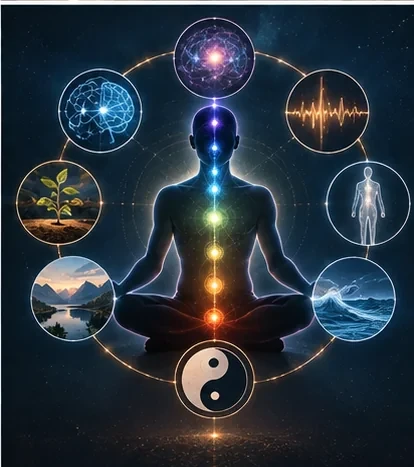
The name Quantum Healing Field is not only branding for me.
The word “field” describes the way I tend to understand a person.
Not as a single point.
Not as one symptom.
Not as one method.
But as a network of relationships.
Body.
Breath.
Emotion.
Thought.
Habit.
Relationship.
Consciousness.
Meaning.
Intuition.
And, for some people, a spiritual dimension as well.
I do not use the word “quantum” to claim that everything I do is quantum physics.
That is not the claim.
For me, it is a metaphor for complexity, possibility, interconnection, and the fact that meaningful change does not always move in a straight line.
A person is not a repair project
This may be the most important point in the entire article.
When we have a lot of tools, it becomes easy to see a person as a project.
Clear this.
Release that.
Open this.
Balance that.
Activate something else.
But a person is not a machine entering a repair shop.
Not everything requires fixing.
Sometimes the work is change.
Sometimes understanding.
Sometimes acceptance.
Sometimes a boundary.
Sometimes a decision.
Sometimes stability.
Sometimes the most useful result of a session is simply that a person leaves a little more connected to themselves and a little less dependent on me.
The Person Comes First. The Method Follows.
If I had to reduce the entire approach to one sentence, it would be this:
The person comes first. The method follows.
I continue studying not because I want to use more techniques on more people.
I study because I want more ways to recognize what may help, what may not help, and when a tool should remain unused.
That is also the heart of my Approach page.
Training gives me tools.
Intuition helps me sense when they may be useful.
Responsibility reminds me when to put them down.
Frequently Asked Questions
Why not simply specialize in one method?
Deep specialization can be extremely valuable, and for some practitioners it is the right path. I work with several approaches because it is not always clear in advance which entry point will best serve the person. Having more than one framework allows the question to remain open long enough for the session itself to show what is most relevant.
How do you decide which method to use?
The decision develops from the person, the goal, their level of activation, the way they describe their experience, and what feels safe and appropriate. Sometimes that means Breathwork, sometimes conversation, sometimes energy-oriented work, and sometimes a guided process such as BQH.
Do you combine several methods in every session?
No. More tools do not mean more tools should be used. A session may remain almost entirely conversational or stay within one approach. Flexibility means having the option to choose, not an obligation to combine.
Does intuitive work mean there is no structure?
No. There is still a clear framework: clarification, work, integration, and closure. What remains flexible is the tool used within that framework.
Do you interpret every energetic or spiritual experience?
No. I prefer to leave room for uncertainty. Some experiences may have spiritual meaning for the person, while others may simply remain experiences. Not everything needs an immediate explanation.
When is another professional more appropriate?
When the central issue is medical, psychiatric, psychological, or requires expertise I do not have, referral may be the most appropriate next step.
Where can I see all session options?
You can begin with the Sessions page and explore each approach individually.
You do not need to choose the method before you understand the question
If you already know exactly what you are looking for, you can go directly to the relevant session page.
If you are not yet sure whether the next step is breathwork, conversation, energy work, holistic health, or a consciousness journey, that is also completely fine.
You do not have to arrive with the answer.
We can begin with the person.
The method can come later.
Keep reading
Work offered through Quantum Healing Field is complementary and oriented toward wellbeing, awareness, and personal development. It does not replace medical, psychological, or psychiatric diagnosis or care.